The fruit fly has around 140,000 neurons. Its brain consumes less than six milliwatt-hours of energy per day — roughly the same as leaving a single LED on for one minute. In that tiny biological package, a fly can navigate complex environments, detect smells across distance, avoid threats, and learn from experience.
DARPA has decided this is the benchmark for its next generation of battlefield computers.
In early March 2026, the Defense Advanced Research Projects Agency issued Special Notice DARPA-SN-26-48 for a program called O-CIRCUIT — short for Organoid Cytomorphic Intelligence Resulting from Convergent Understanding and Information Transfer. The name is a mouthful. The idea is straightforward: build computers from living neurons, not silicon transistors, and deploy them in places where power is too scarce for conventional AI.
O-CIRCUIT is currently in its pre-solicitation phase — the notice was issued to attract research performers, with a formal solicitation to follow on SAM.gov. The program has not yet entered full execution. But the intent is unambiguous, and the direction it signals is significant: the United States military considers biological computing not a curiosity, but a strategic priority.
The Problem DARPA Is Trying to Solve
Modern AI has an energy problem that is especially acute at the battlefield edge.
Running AI inference in a data center is expensive but manageable — you build bigger power infrastructure. Running it on a drone, a soldier’s equipment, or a remote autonomous sensor is a different problem entirely. Power is finite, resupply is dangerous, and every watt spent on computation is a watt not spent on propulsion, communication, or survival.
Modern AI training and inference has significant energy requirements, DARPA researchers explain. This creates challenges for military operations at the tactical edge, where power is limited and resupply is difficult.
Conventional solutions — lower-power chips, better batteries, neuromorphic silicon — exist but hit physical limits. You can make a silicon chip more efficient, but you cannot make it as efficient as biology. The human brain processes vastly more information than any chip we’ve built, on around 20 watts. A fruit fly navigates three-dimensional space and tracks chemical gradients in real time on six milliwatt-hours per day.
DARPA’s bet with O-CIRCUIT is that you don’t have to simulate this efficiency. You can use the actual biological substrate.
What O-CIRCUIT Actually Is
The O-CIRCUIT program envisions unlocking operational advantages by developing unconventional biological processing units — BPUs — for edge learning and inference with minimal power draw, measured in milliwatt-hours per day.
A BPU, in this framing, goes beyond what commercial biocomputers have built so far. O-CIRCUIT specifically calls for organoids composed of mixed cell types — neural cells for processing, glial cells for support and signal modulation, and immune cells for structural maintenance. This isn’t just neurons on a chip. It’s a more complete biological architecture, closer to how a real brain region is actually organized, interfaced with electronics that can send signals in and read signals out. The biological component handles learning and inference. The silicon handles input/output.
What makes O-CIRCUIT different from a university research project is scope, structure, and stakes.
DARPA has structured O-CIRCUIT as a 42-month effort consisting of an 18-month Phase 1, a 12-month optional Phase 2, and a 12-month optional Phase 3. The program is divided into two task areas.
Task Area 1: Architecture — Build a BPU capable of sophisticated learning. The benchmark task is playing a video game at close to human-level proficiency. DARPA has floated Ms. Pac-Man as an example. This mirrors what commercial labs have already demonstrated — Cortical Labs’ neurons playing Pong and Doom — but frames it as a capability baseline rather than a demo. The goal is a standardized, replicable architecture for biological computation.
Task Area 2: Action — This is where it gets genuinely novel. Task Area 2 focuses on integrating a biological olfactory sensor system into a BPU and then into a drone navigation system for biocompute-based chemotaxis. DARPA is looking for systems that can detect tens of odorants and navigate an unmanned drone toward an odorant within a limited time window.
Translation: DARPA wants a drone guided not by GPS or cameras, but by a biological nose. Living neurons, processing real chemical signals from the environment, directing flight.
Why a Biological Nose?
The olfactory angle is not arbitrary. Smell is, in computational terms, one of biology’s most impressive feats. The human nose can distinguish roughly one trillion different odor combinations. Dogs track scent trails across days and miles. Insects navigate using chemical gradients with extraordinary precision.
Silicon struggles here. Building artificial chemical sensors that approach biological sensitivity requires complex hardware and still falls short. Building systems that can classify and respond to arbitrary chemical environments in real time — especially in unpredictable, outdoor conditions — is an unsolved engineering problem.
Biology solves it by default.
A drone guided by a biological olfactory system could theoretically track chemical signatures — explosives, fuel, biological agents, nerve agent precursors — in ways that current sensor technology cannot match. The military term for this threat category is CBRN: chemical, biological, radiological, and nuclear. Detecting these substances at distance, in real time, in unpredictable outdoor environments, is one of the hardest sensing problems in defense. Biology handles it routinely. A dog can detect trace explosives through multiple layers of packaging. Insects navigate toward specific chemical sources across open terrain. O-CIRCUIT is asking whether that capability can be engineered into a deployable system.
The challenge is to develop trainable biological processing units that provide sophisticated inference and drone guidance via neural olfactory sensing. That framing — trainable — is key. DARPA doesn’t want a fixed sensor. It wants a system that learns.
The Companies Already in This Space
O-CIRCUIT didn’t emerge in a vacuum. The commercial biocomputing sector has been building toward exactly this kind of application for several years, and DARPA has been watching.
A number of companies and research labs are developing biological processing units. FinalSpark develops living-neuron organoids attached to electrodes for basic computing tasks, available on a research cloud platform. Similarly, Cortical Labs operates its own cloud, with neurons living on silicon hardware.
Cortical Labs, the Melbourne company behind the CL1 biocomputer, counts In-Q-Tel among its investors — the CIA’s venture arm, which exists specifically to fund dual-use technologies of interest to the intelligence community. The CIA was paying attention before DARPA made it official.
FinalSpark’s Neuroplatform, which gives researchers cloud access to 160,000 living human neurons via Python API, has already attracted nine research institutions and dozens of universities to its waiting list. Its architecture — remotely accessible biological compute, maintained in a central facility — is precisely the kind of infrastructure a military program needs for distributed testing.
Researchers at Johns Hopkins and Pomegranate Intelligence mapped a fruit fly larva brain to a BPU and were able to play chess. That experiment, using the connectome of an actual insect brain as a blueprint for a biological processing unit, is a direct precursor to what O-CIRCUIT’s Task Area 2 envisions at larger scale.
The pieces are in place. DARPA is now providing the funding and the requirements to assemble them.
The Broader Strategic Picture
O-CIRCUIT is one program, but it reflects a pattern. DARPA created the O-CIRCUIT program through its Biological Technologies Office, which seeks to develop a new class of biologically inspired computer by harnessing the incredible efficiency of biological systems. The Biological Technologies Office — BTO — has a mandate that spans pandemic preparedness, warfighter enhancement, and biological manufacturing. Adding biological computing to that portfolio signals that the Pentagon sees wetware as infrastructure, not experiment.
The 42-month timeline is significant. It means DARPA expects meaningful demonstrations by 2029 — not a decade away, not a proof of concept. Operational capability, or something close to it.
This matters beyond the military. DARPA has a reliable track record of funding technologies that eventually escape the defense context entirely. The internet began as ARPANET. GPS began as a military navigation system. Voice recognition, long funded by DARPA’s speech understanding programs, is now in every smartphone. When the Pentagon invests seriously in a technology, it tends to pull the whole field forward.
Commercial biocomputing labs building BPUs for research are now building them for a market that includes the most well-funded R&D organization on earth. That changes the pace of development.
What This Means for Biocomputing
For a field that has spent years explaining itself to skeptical audiences — yes, we’re actually using real neurons, no it’s not science fiction — the O-CIRCUIT announcement is a form of institutional validation that money alone can’t buy.
DARPA programs require demonstrated results. They involve independent evaluation, capability milestones, and the kind of engineering rigor that produces replicable, deployable systems. If O-CIRCUIT succeeds, it won’t just produce a drone guided by a biological nose. It will produce a standardized framework for what a BPU needs to do, how to build one, and how to verify it works.
That framework will matter far beyond the battlefield. The same biological processing unit that navigates a military drone toward a chemical signature could, in a different context, navigate a medical device toward a disease marker inside a body. The same architecture that learns to play Ms. Pac-Man at near-human proficiency could accelerate drug discovery, environmental monitoring, or edge AI in places where grid power doesn’t reach.
The fruit fly brain consuming six milliwatt-hours per day wasn’t designed for efficiency. It evolved for survival. DARPA is now asking whether we can borrow that design — and what we might do with it once we have.
Biocomputer.com covers the full spectrum of biological computing — from commercial platforms to government programs. Related reading: The Companies Building the Biocomputer Era Right Now, You Can Rent Living Human Brain Cells as a Biocomputer — Right Now
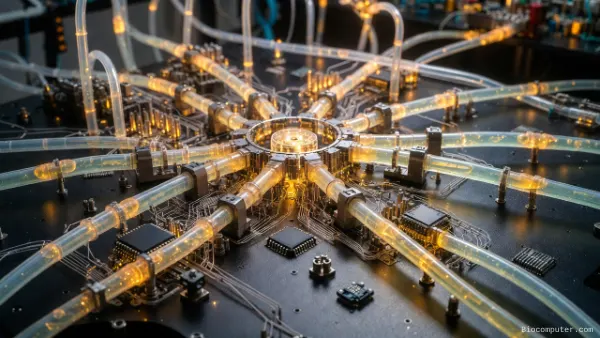
image created with ai (Grok)