Imagine running experiments on living human brain cells without a lab, without specialized equipment, and without a biology degree. Just a laptop and a Python script. That’s not a thought experiment — it’s a service you can sign up for today.
FinalSpark, a Swiss startup based in Vevey, has built what may be the world’s most unusual cloud platform: the world’s first commercially accessible biocomputing research platform, launched on May 15, 2024. It’s not a simulation. It’s not silicon designed to mimic a brain. It’s a “wetware” architecture — a blend of biology, software, and hardware — forming what the company calls a bioprocessor.
160,000 Living Human Neurons, Accessible via API
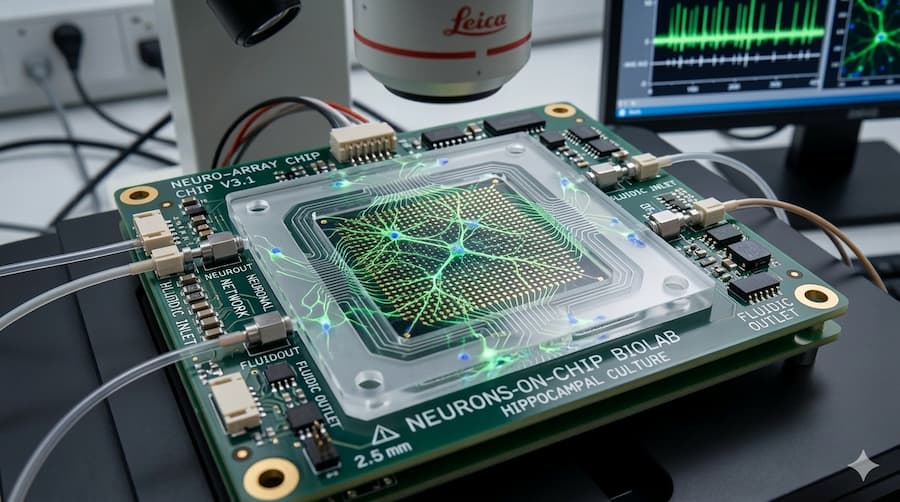
The Neuroplatform contains 16 brain organoids arranged across 4 Multi-Electrode Arrays (MEAs), with 4 organoids per MEA. Each organoid holds roughly 10,000 neurons, bringing the total to approximately 160,000 neurons system-wide. These spherical “forebrain organoids” measure just 0.5mm in diameter and are interfaced with 8 electrodes each — 32 total per MEA — capable of both stimulating and recording neural activity bidirectionally.
Each organoid is grown from human stem cells — not extracted from an actual brain. FinalSpark takes about four months to produce a single organoid. The platform’s redesigned microfluidic life-support systems now keep organoids viable for over 100 days — a dramatic improvement from early development when cells survived only a few hours.
To keep neurons alive and responsive, the platform runs microfluidic nutrient systems, digital monitoring cameras, and UV light systems for controlled dopamine delivery — essentially a miniature life-support infrastructure running continuously in Vevey while you experiment from anywhere in the world.
A Million Times More Efficient Than Silicon
The headline claim is striking: FinalSpark says its bioprocessors consume roughly one million times less energy than traditional digital processors for equivalent tasks. The company frames this as a direct response to AI’s growing energy crisis — training a single large language model can emit as much CO₂ as several cars over their lifetimes, and data center demand is accelerating.
Neurons achieve this efficiency through fundamentally different physics than transistors. They don’t toggle between binary states at gigahertz frequencies. They fire, adapt, and self-organize based on experience. The human brain — running 86 billion neurons — operates on roughly 20 watts total. Evolution spent hundreds of millions of years optimizing that architecture. Silicon hasn’t caught up.
That biological efficiency is both the Neuroplatform’s biggest selling point and its fundamental engineering challenge.
What Researchers Actually Do on the Platform
The Neuroplatform is a fully integrated remote research environment. Researchers use a Python API to deliver electrical stimulation patterns, trigger neurotransmitter release — dopamine, glutamate, serotonin — and record neural responses in real time. Jupyter Notebooks are included for interactive experimentation, along with data storage, backup, and 24/7 technical support.
The API also controls microfluidic pumps, cameras, and UV lights directly, enabling complex automated experiments including closed-loop strategies where the system adapts stimulation based on live neural responses. FinalSpark has accumulated over 20 terabytes of experimental data across roughly 10 million neurons tested since the platform launched.
In practice, research groups are using this to study synaptic plasticity, explore bio-inspired robotics algorithms, investigate organoid responses to different stimuli, and probe whether biological networks can one day slot meaningfully into AI pipelines.
Who’s Using It
The platform currently serves institutions including the University of Michigan, Free University of Berlin, University of Exeter, Lancaster University, University of York, Université Côte d’Azur, Oxford Brookes University, and EPFL — where FinalSpark ran a Neuro-X workshop for students in March 2025. In December 2025, the University of Bristol published peer-reviewed research based on Neuroplatform experiments. In February 2026, FinalSpark presented a poster on wetware computing at a Maxwell Biosystems event.
The access model is deliberately dual-track. Academic institutions can apply for free access — without retaining intellectual property on findings. Paying commercial users, at $500 per user per month, retain rights to proprietary applications developed on the platform. This structure lets FinalSpark foster broad scientific exploration while protecting its commercial path.
Where the Science Actually Stands
FinalSpark is transparent about the gap between the vision and today’s reality.
Current experiments are limited to storing roughly one bit of information per organoid. Basic stimulus-response behaviors are achievable. The co-founders describe biocomputers as genuine “black boxes” — unlike digital systems, their internal state is opaque and the protocols for reliably programming them are still being invented. As Fred Jordan has said, these methods don’t yet exist and the field is in the early stages of discovering them.
That honesty is notable. This is an experimental platform operating at the frontier of what anyone understands about biological computation.
A 10-Year Roadmap
At a presentation in London in June 2025, FinalSpark laid out its roadmap. The near-term goal (2024–2026) is platform optimization: extending organoid lifespan from 100 to 200+ days and increasing information density from 1 bit to 10+ bits per organoid. Phase 2 (2026–2028) targets commercial pilots, starting with pharmaceutical applications where biocomputing’s biological substrate has natural advantages — modeling neurological disease, testing drug candidates against living human neural tissue before animal trials.
The 10-year vision: bio-servers accessible via the cloud, delivering computational power for generative AI at a fraction of the energy cost of GPU clusters. FinalSpark is also seeking CHF 50 million in funding to achieve what they call “in vitro learning” — genuine, demonstrable machine learning on biological substrate.
The Competitive Landscape
FinalSpark is not alone. The clearest competitor is Cortical Labs, the Australian biotech that launched the CL1 in March 2025 — a self-contained desktop biocomputer running 800,000 neurons on a silicon chip, available for $35,000 or via cloud rental. Cortical Labs recently announced plans for biological data centers in Melbourne and Singapore, with ambitions to scale toward 1,000 CL1 units.
The strategic difference is fundamental: FinalSpark offers remote access to shared biological infrastructure as a service. Cortical Labs sells physical hardware. Both are building toward the same future — they’re just taking different routes.
Beyond these two, neuromorphic silicon companies like Intel (Loihi) and BrainChip simulate neural behavior in transistors. FinalSpark uses actual neurons. These are different bets on different futures, and it’s not clear yet which architecture will prove more useful at scale.
The Ethical Overhang
Growing human neural tissue for computation raises questions that biology and philosophy haven’t fully resolved. FinalSpark engages philosophers directly as part of its research process, acknowledging that questions of consciousness and moral status in lab-grown neural tissue are genuinely open — not marketing noise, but real scientific uncertainty.
At 160,000 neurons, current neuroscience consensus holds that organoids have no subjective experience. But the honest position is that reliable tests for consciousness at any scale don’t exist. As organoid complexity grows — which is exactly what FinalSpark’s roadmap intends — those questions will need to be answered, not deferred.
Try It Yourself
FinalSpark runs a live visualization at finalspark.com/live — real electrical activity from living neurons, viewable in any browser, updated in real time. It is a genuinely strange thing to look at.
For researchers ready to go deeper, access applications are open at finalspark.com/neuroplatform. FinalSpark also maintains a Discord community of over 1,000 members for those following the field without committing to a subscription.
The age of renting neurons — even a very small colony of them — has quietly arrived.
Related: Human Brain Cells on a Chip Are Now for Sale — The World’s First Commercial Biocomputer
Hero image generated with AI (Gemini)