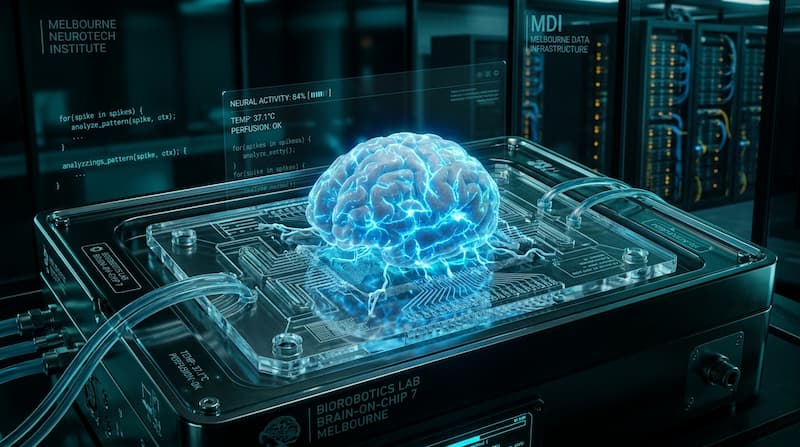
In March 2025, Cortical Labs shipped the CL1 — the world’s first commercial biological computer built with real human neurons grown on silicon. One year later, they stacked 120 of those units into a biological data center prototype in Melbourne, with plans for up to 1,000 units in Singapore.
FinalSpark meanwhile gives researchers cloud access to hundreds of living brain organoids via simple Python code. At the same time, Neuralink has 21 human trial participants worldwide, with its new VOICE trial pushing toward conversational speech restoration.
The narrow definition of a biocomputer — using living neurons, organoids, DNA or proteins as the actual computing substrate — is expanding fast. At BioComputer we track the full convergence of biology and computation because that’s where the real momentum sits in 2026.
Wetware Hardware Finally Ships
Cortical Labs built the CL1 as a self-contained “body-in-the-box” unit with nutrient flow, waste management, and a biological operating system called biOS. Each unit runs on roughly 30 watts while supporting closed-loop interaction between living neurons and software.
The neurons, derived from human stem cells, can survive up to six months. Developers deploy Python code and watch the biological neural network adapt in real time. Early demos already include complex game learning far beyond the 2022 Pong experiments.
Cortical Labs didn’t stop at single units. In March 2026 they launched a biological data center prototype in Melbourne with 120 CL1 units and partnered with DayOne Data Centers for a larger facility in Singapore. An initial validation phase at the National University of Singapore starts with 20 units.
FinalSpark took a different route with its Neuroplatform. Researchers anywhere in the world access living brain organoids remotely, run stimulation and recording experiments, and collect massive datasets — already over 18 terabytes across more than 1,000 organoids. Recent updates pushed reliable organoid lifespan beyond 100 days, with some reaching six to seven months of useful activity.
These systems deliver the original promise of biocomputing: extreme energy efficiency and inherent adaptability that silicon struggles to match.
The Broader 2026 Definition Takes Shape
At BioComputer.com we define a biocomputer as any system where living biology and digital computation deeply intersect to process information, learn, adapt, or solve problems.
This umbrella covers:
- Pure wetware processors such as the CL1 and FinalSpark organoids
- Brain-computer interfaces that turn the living human brain into a hybrid system
- Medical and pharma applications using organoids for drug screening and disease modeling
- Synthetic biology with programmable gene circuits inside the body
- Biohybrid systems blending living tissue with electronics for sensing or prosthetics
The narrow wetware core remains exciting for low-power AI and sustainable data centers. Yet the bigger funding, patient impact, and clinical progress in 2026 come from the intersections — especially medical restoration and human-relevant testing.
Brain-Computer Interfaces Enter Clinical Scale
Neuralink now has 21 trial participants enrolled worldwide. The company completed two years of human testing with no major safety incidents reported and is accelerating enrollment.
Its new VOICE clinical trial targets conversational speech restoration for people with ALS, stroke, or other conditions that impair speech production. The goal is real-time thought-to-speech at speeds approaching 140 words per minute.
Other players including Synchron and Paradromics continue advancing implantable interfaces focused on restoring independence for paralyzed patients. These systems turn the human nervous system itself into a programmable hybrid biocomputer.
Organoid Intelligence Powers Pharma and Discovery
Organoid intelligence (OI) uses brain organoids not just for basic computing but for more human-relevant drug screening, toxicity testing, and personalized “patient-on-a-chip” models.
Johns Hopkins and other labs explore how these mini-brains can model Alzheimer’s, epilepsy, and other conditions with greater accuracy than traditional methods. The approach promises to reduce reliance on animal testing while accelerating discovery.
Market projections reflect the momentum. The broader organoids sector is expected to grow at double-digit CAGRs through 2034, driven by demand for better disease modeling and regenerative medicine tools.
Synthetic Biology Brings Computation Inside the Body
Engineered cells with logic-gated gene circuits now act as tiny biological computers. These cells can sense disease states inside the body and release targeted therapies on demand.
AI tools increasingly help design these genetic programs, speeding the move from research to therapeutic applications such as advanced CAR-T cell therapies for cancer.
Challenges That Still Matter
Maintaining long-term organoid health at scale remains difficult. Ethical questions around “intelligence-in-a-dish” — especially when systems demonstrate learning and memory — demand serious attention. Integration between biological and silicon components, regulatory pathways, and public perception will all shape how fast the field can grow.
What Kind of Future Are We Actually Building?
The future of computation will not be purely silicon or purely biology. It will live in the powerful places where the two meet.
At BioComputer we track the entire spectrum because this convergence touches energy, medicine, ethics, and what it means to be intelligent.
References
- Data Center Dynamics (March 2026). Australian startup Cortical Labs partners with DayOne to unveil biological data center prototype. https://www.datacenterdynamics.com/en/news/australian-startup-cortical-labs-unveils-biological-data-center-prototype/
- Bloomberg (March 2026). Human brain cells run new data centers in Singapore, Melbourne. https://www.bloomberg.com/news/articles/2026-03-09/human-brain-cells-run-new-data-centers-in-singapore-melbourne
- Reuters (January 2026). Elon Musk’s Neuralink says it has 21 participants enrolled in trials. https://www.reuters.com/legal/litigation/elon-musks-neuralink-says-it-has-21-participants-enrolled-trials-2026-01-28/
- Frontiers in Science (2023, with ongoing citations into 2025). Organoid intelligence (OI): the new frontier in biocomputing. https://www.frontiersin.org/journals/science/articles/10.3389/fsci.2023.1017235/full
- FinalSpark company updates (2025–2026). Neuroplatform and 6-month research summary. https://finalspark.com/
Related: Cortical Labs CL1 Deep Dive · Neuralink Trial Progress · Organoid Intelligence Explained
Feature image: AI-generated using Gemini.