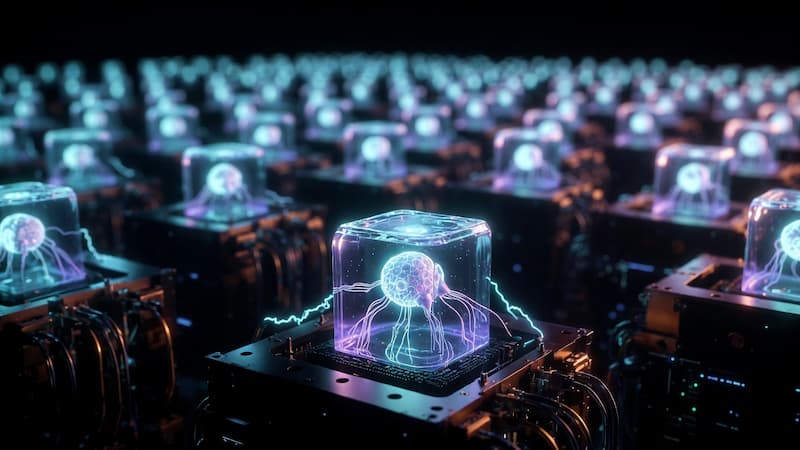
In the SaaS era, competitive advantage came from better code, bigger clouds, and user lock-in. That world is fading fast. As foundation models become widely accessible and AI agents proliferate, every company can build or buy comparable intelligence. The war for differentiation is shifting to a single metric: who can deliver the most useful intelligence output while consuming the least energy?
The answer, increasingly, is not found in silicon. The human brain performs sophisticated cognition on roughly 20 watts. Today’s leading AI clusters require megawatts for comparable operations — a gap estimated at 100,000× to 1,000,000× in energy efficiency. That gap is not a rounding error. It is the central economic fact of the next decade.
The most valuable “digital real estate” of the 2030s will be proprietary wetware — patented biological architectures — paired with energy-efficient bio-infrastructure. Biology already solved the efficiency problem. The intelligence economy is only now catching up.
The Intelligence Commodity Trap Is Already Closing
When core AI capabilities are democratized, pure silicon-based systems face a structural problem. They scale intelligence by burning more power. Higher compute demand means higher marginal costs, grid constraints, and direct exposure to rising electricity prices.
Global data center power consumption is projected to roughly double — reaching around 945 TWh by 2030 — with AI workloads as the primary driver. In some scenarios, U.S. data centers alone could consume 9–17% of national electricity output. Capital expenditures for AI-ready infrastructure are already estimated in the trillions of dollars.
For any company building AI products, energy and cooling represent a large and growing share of operating costs. As model performance gaps narrow and customers optimize with agents, margins come under pressure from every direction. In this environment, radical cost efficiency — specifically on the energy side — stops being a nice-to-have and becomes the only reliable path to profitability.
Companies that remain fully dependent on power-hungry silicon risk becoming the high-cost producers of the intelligence age.
Biocomputing’s Numbers Are Not Theoretical — They Are Already Live
Two commercial examples make the case concrete.
FinalSpark’s Neuroplatform uses living human brain organoids for neural computation and demonstrates up to one million times less energy consumption than digital processors performing equivalent tasks. Their systems operate remotely, offered as a low-carbon alternative to GPU-based compute.
Cortical Labs’ CL1 — the world’s first commercial biocomputer — integrates living human neurons on a silicon chip. Each CL1 unit consumes approximately 30 watts, less than a handheld calculator. A full rack draws just 850–1,000 watts, a fraction of what a GPU-based AI rack requires. Biological data center prototypes are already live in Melbourne with 120 units, with Singapore scaling toward 1,000 units.
These systems are event-driven and sparse. They integrate memory with processing, eliminating the energy waste of constant data movement that plagues traditional architectures. That is not a marginal improvement. It is a different physics.
Hybrids Still Need Biology — You Cannot Remove Wetware from the Equation
The dominant near-term architecture will likely be hybrid: silicon handles high-speed, precise mathematical operations; wetware handles adaptive learning, pattern recognition, and real-time decision-making. This is a reasonable transition path.
But the critical point is this: even hybrid systems depend on the biological layer to deliver orders-of-magnitude energy savings. A hybrid without a meaningful wetware component still carries the heavy energy burden of a silicon-dominant design. The efficiency gains come specifically from the biology. Strip it out, and you are back to the same cost structure.
This is why Intelligence-as-a-Utility — the emerging model where intelligence is metered by outcomes or capacity rather than tokens or seats — will reward whoever can generate the most “thought” for the lowest “calorie” count. Biology wins that metric by a factor that silicon cannot close through engineering alone.
Challenges are real: maintaining living cultures over time, scaling biological interfaces, addressing ethical and regulatory questions around sentient-adjacent systems. Execution will matter enormously. But the physics and economics point in one direction.
The New Playbook: Own the Wetware Real Estate Now
Forward-thinking organizations are already moving on three fronts:
- Securing patents on unique biological architectures and neuron-silicon interface designs before the field consolidates
- Building or partnering on low-footprint wetware hosting facilities — optimized for biological stability and nutrient systems, not raw power draw
- Launching Wetware-as-a-Service (WaaS) models that charge for intelligence outcomes, not compute hours
Just as hyperscale data centers defined infrastructure value in the SaaS era, proprietary wetware and energy-efficient bio-infrastructure will define value in the intelligence era. The companies that lock in biological IP and operational knowledge now will hold structural cost advantages that pure-silicon competitors cannot replicate later.
The SaaS era rewarded scale and lock-in. The intelligence era will reward calorie efficiency.
Biology Already Won This Race — The Economy Just Hasn’t Caught Up Yet
The human brain is not an inspiration. It is a benchmark. Twenty watts. Continuous learning. Adaptive pattern recognition at a scale no GPU cluster has matched at equivalent power consumption. Evolution spent hundreds of millions of years solving the efficiency problem that AI infrastructure is only now confronting.
At BioComputer, we believe the intelligence economy will ultimately be won by whoever can think the most while consuming the least. Wetware is not optional. It is not a research curiosity. It is the foundational layer of the next infrastructure cycle — and the clock on securing that real estate is already running.
The calorie is the new dollar. Biology mastered the exchange rate long before we did.
References
- FinalSpark. (2024). Neuroplatform: Remote access to living brain organoids. FinalSpark. https://finalspark.com/neuroplatform/
- Cortical Labs. (2025). CL1: The world’s first commercial biological computer. Cortical Labs. https://corticallabs.com/cl1
- International Energy Agency. (2024). Electricity 2024: Analysis and forecast to 2026. IEA. https://www.iea.org/reports/electricity-2024
- Goldman Sachs Research. (2024). AI is poised to drive 160% increase in data center power demand. Goldman Sachs. https://www.goldmansachs.com/insights/articles/AI-poised-to-drive-160-increase-in-power-demand.html
- Kagan, B.J. et al. (2022). In vitro neurons learn and exhibit sentience when embodied in a simulated game-world. Neuron. https://doi.org/10.1016/j.neuron.2022.09.001
Related: What Is a Biocomputer in 2026? · FinalSpark Neuroplatform: The First Biological Cloud · Cortical Labs CL1: First Commercial Biocomputer
Feature image: AI-generated using Grok