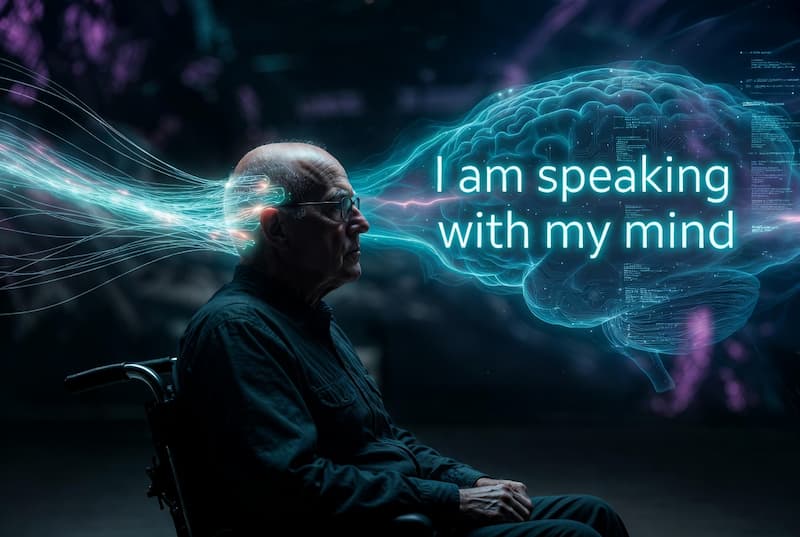
In a quiet moment captured on video, Kenneth Shock looks directly at the camera and says, “I am speaking to you with my mind.”
His lips do not move. There is no strained breath, no mechanical click of a speech-generating device. The words emerge in his own voice — warm, deliberate, unmistakably his — synthesized in real time from neural patterns decoded by a coin-sized implant in his brain.
Diagnosed with ALS in 2024, Kenneth had gradually lost the ability to speak. By early 2026, the disease had silenced him. Now, as the second participant in Neuralink’s VOICE clinical trial (NCT07224256), he is reclaiming one of the most intimate expressions of human identity: the voice that carries thought into the world.
This is not science fiction. It is an early, investigational demonstration of a high-bandwidth brain-computer interface translating intended speech directly into audible language.
For biocomputer.com — dedicated to the convergence of biology, computation, and the reimagining of the human mind as an extensible system — this moment is profoundly significant. It marks not merely a medical advance, but a tangible step toward treating the brain as a living computational substrate: one that can interface seamlessly with silicon, AI, and synthetic biology to restore, augment, and perhaps one day transcend our biological limits.
The Human Story Behind the Implant
ALS progressively destroys motor neurons, robbing people of movement, speech, and eventually the ability to breathe independently. For those who become “locked in,” cognition remains intact while the body becomes a prison. Traditional assistive technologies — eye-tracking keyboards, sip-and-puff switches, basic speech synthesizers — offer communication at painfully slow rates, often 5–20 words per minute. They demand constant visual attention and enormous cognitive overhead.
Neuralink’s N1 implant changes the equation.
Implanted in January 2026 into the speech motor cortex via the company’s R1 surgical robot, the device’s 1,024 ultra-thin electrodes (distributed across 64 threads thinner than a human hair) record high-resolution neural activity. Advanced machine-learning models decode the patterns corresponding to imagined phonemes — the building blocks of speech — and map them to synthesized audio in Kenneth’s pre-ALS voice.
The result feels instantaneous and naturalistic. No mouthing. No typing. Just thought-to-sound.
Kenneth is not the first to receive the N1. He follows participants in the PRIME trial who demonstrated cursor control, gaming, and even web browsing via thought alone. But VOICE represents a deliberate pivot: the same hardware architecture, now tuned for the faster, more parallel neural dynamics of speech production.
Speech motor cortex neurons fire in intricate, high-dimensional patterns — far more complex than the relatively straightforward kinematics of hand movement. That Neuralink’s decoder generalizes across these domains suggests a flexible, scalable foundation for future biocomputer applications.
How the Technology Works: A Biocomputer in Action
At its core, the N1 is a bidirectional interface between biological wetware and digital hardware.
Electrodes detect action potentials — the electrical “spikes” of individual neurons. On-device ASICs amplify, filter, and digitize these signals at low power. Data streams wirelessly via Bluetooth to the Neuralink app, where real-time AI models trained on Kenneth’s own attempted speech predict intended words or phonemes and route them to a voice synthesizer.
This is biocomputing in the most literal sense: the brain’s native computational language (neural firing rates and population codes) is read, interpreted, and translated by silicon into an output the external world can understand.
Unlike earlier BCIs that relied on surface electrodes or fewer channels, Neuralink’s thread-based, high-density array minimizes tissue damage while maximizing signal fidelity. The system also preserves the patient’s original vocal timbre by training on pre-disease recordings — preserving a fragment of personal identity that generic text-to-speech cannot.
Critically, this is not “mind reading” in the dystopian sense. The implant only accesses signals the user intentionally generates for speech. It does not decode spontaneous inner monologue or private thoughts.
Yet the philosophical boundary is blurring. If we can decode intended speech, how long until emotional prosody, intent nuance, or even imagined concepts become transmissible?
A Brief History of Speech Restoration
The dream of restoring speech via brain signals is not new.
Early 20th-century experiments with EEG laid groundwork for non-invasive BCIs, but they lacked the spatial and temporal resolution needed for fluent output. The real breakthroughs came in the 2000s–2010s with intracortical microelectrode arrays. Pioneering work by researchers like Frank Guenther and Jon Brumberg used the Neurotrophic Electrode to enable a locked-in participant to produce vowel sequences via imagined speech, achieving closed-loop feedback with under 50 ms latency as far back as 2009–2010.
More recent milestones accelerated progress dramatically. In 2023, UCSF and Stanford teams independently demonstrated high-performance speech neuroprostheses — one reconstructing entire spoken sentences from attempted speech at up to 62 words per minute, the other decoding “inner speech” (silent thought) in a paralyzed woman. Word error rates dropped as low as 9–24% on vocabularies ranging from 50 to 125,000 words.
Neuralink’s contribution is scale and integration: 1,024 channels, robotic precision implantation, wireless operation, and a focus on long-term biocompatibility.
A 2025 review in the Annual Review of Biomedical Engineering by Sergey Stavisky underscores the clinical urgency: speech BCIs must achieve conversational speeds (roughly 120–160 wpm) with low error rates and minimal cognitive load to truly restore dignity. Kenneth’s early results hint that we are approaching that threshold.
The Biocomputer Lens: Beyond Restoration Toward Augmentation
At biocomputer.com, we view technologies like Neuralink not as isolated medical devices but as prototypes of the human biocomputer — a concept echoing John C. Lilly’s 1960s–70s explorations of the mind as programmable wetware, now fused with modern synthetic biology and organoid intelligence.
Kenneth’s implant is a hybrid system. Biological neurons provide the raw computational substrate — distributed, energy-efficient, plastic. Silicon and AI supply precision decoding and output synthesis. This mirrors emerging “living computers” such as Cortical Labs’ CL1 (synthetic biological intelligence using human brain organoids on silicon) or FinalSpark’s neuron-based processors.
The same principles apply: record from living neural networks, train them on tasks, extract meaningful computation — only here scaled to the intact human brain.
Future convergence feels inevitable. What if speech-decoding threads could one day interface with lab-grown cortical organoids for memory augmentation? Or integrate with DNA-based data storage for on-demand knowledge recall?
The VOICE trial is an early proof that the brain’s native language can be read and written at scale. The next chapters will explore whether we can edit that language — restoring not just voice, but perhaps lost memories, emotional regulation, or even novel sensory modalities.
Ethical Horizons and Societal Ripples
With great capability comes profound responsibility.
Thought-to-speech raises immediate questions of mental privacy: if inner speech can be decoded, who owns the boundary between thought and expression? Equity of access is another urgent concern. Today’s trials serve a handful of participants. Tomorrow’s approved therapy must not become a luxury for the wealthy while the global majority with neurodegenerative diseases are left behind.
There are also philosophical stakes. Voice is deeply tied to identity. By restoring Kenneth’s pre-ALS timbre, Neuralink preserves a fragment of selfhood that disease had erased. Yet synthetic voices risk commodification — deepfake audio and AI-generated personas could blur the line between authentic expression and algorithmic mediation.
Neuralink emphasizes the investigational nature of the technology: no guaranteed benefits, long-term safety data still accruing, devices not commercially available. This humility is essential. True biocomputing progress must prioritize patient safety, informed consent, and open dialogue with ethicists, neuroscientists, and the disabled community itself.
Toward a Future Where Silence Is Optional
Kenneth Shock’s quiet declaration — “I am speaking to you with my mind” — is more than a personal victory.
It is a signal flare for the biocomputer age: a future in which the boundary between mind and machine dissolves, not through domination of biology by silicon, but through respectful symbiosis.
Speech is only the beginning. Motor restoration, sensory feedback, cognitive enhancement, and even collective intelligence via networked BCIs may follow. For those of us tracking the frontier of biological computation, this trial is cause for measured celebration.
The brain has always been nature’s most sophisticated computer.
We are simply learning to read its source code — and, for the first time, give it a voice again.
Watch Kenneth’s full story: Neuralink YouTube Video If you or a loved one may qualify for Neuralink trials, visit the Patient Registry.
References
- Neuralink Official VOICE Trial Page & Video (March 2026)
- ClinicalTrials.gov: NCT07224256 – VOICE Study
- Stavisky, S.D. (2025). “Restoring Speech Using Brain-Computer Interfaces.” Annual Review of Biomedical Engineering
- Willett et al. (2023). “A high-performance speech neuroprosthesis.” Nature
- Brumberg et al. (2010). “Brain-Computer Interfaces for Speech Communication.” PMC
Feature image: AI-generated using Grok