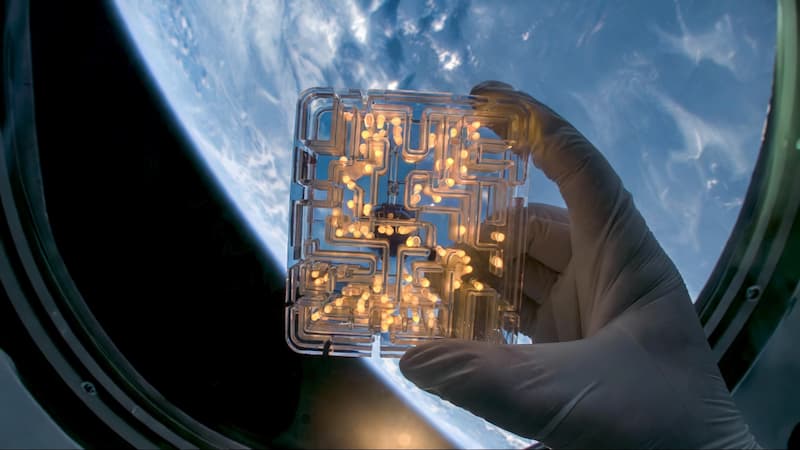
As the four Artemis II astronauts circle the Moon on their 10-day test flight this month, they aren’t the only passengers collecting data. Riding alongside them inside the Orion spacecraft are four USB-sized organ-on-a-chip devices — each built from the crew’s own bone-marrow cells, each running the same gauntlet of cosmic radiation and weightlessness as the humans who donated them.
These aren’t passive sensors logging temperature or pressure. They are living biological computers — personalized tissue analogs designed to capture, at single-cell resolution, exactly how each astronaut’s immune system and blood-forming machinery respond to the most hostile environment our species has ever entered.
This is NASA’s AVATAR investigation — A Virtual Astronaut Tissue Analog Response — and it is one of the clearest demonstrations yet that programmable biology is no longer a lab curiosity. It’s flight hardware.
Organ Chips Are Biological Hardware, Not Simulations
AVATAR was developed by Emulate, Inc. in collaboration with the Wyss Institute at Harvard. Each device is a microfluidic chip roughly the size of a thumb drive. Inside: living human cells arranged in a 3D architecture that mimics the structure and function of real bone-marrow tissue — not a digital approximation, not an animal proxy.
The fabrication process starts on the ground with a simple platelet donation from each crew member. Blood-forming stem and progenitor cells are purified from the remaining sample, combined with supporting vascular cells, and seeded into the chips to recreate a functional bone-marrow niche in miniature. The chips are then loaded into automated hardware built by Space Tango, which keeps the tissue alive, perfused with nutrients, and continuously exposed to the radiation flux and microgravity of deep space.
Crew members perform periodic system checks during the mission. After splashdown, the chips undergo single-cell RNA sequencing — a high-resolution census of how thousands of individual genes changed across the mission. The data is personalized by design: each chip is tuned to one specific human genome, producing readouts that no animal model or silicon simulation can replicate.
Why Bone Marrow — The Radiation Bellwether of Deep Space
Bone marrow is ground zero for blood-cell production: red cells for oxygen transport, white cells for immunity, platelets for clotting. It is also among the most radiation-sensitive tissues in the human body. On Earth, oncologists know this well — cancer therapies that damage marrow suppress immunity and cause anemia. In deep space, without Earth’s magnetic shield, galactic cosmic rays and solar particle events hit marrow-forming cells continuously.
Apollo crews were never far enough from Earth, long enough, to accumulate meaningful radiation doses. Artemis changes that calculus. Future Moon crews will spend weeks on the lunar surface; Mars missions will expose crews to deep-space radiation for 18 months or more each way. Bone-marrow chips flying on the same trajectory as their human donors give NASA a direct, real-time window into immune suppression, anemia risk, and long-term hematological damage — individualized per astronaut, per mission profile.
This is the kind of early-warning biology that makes the difference between a crew that lands on Mars and one that can’t.
Wetware in Orbit — the Biocomputing Angle
At BioComputer we track everything from wetware neural networks grown from human stem cells to DNA-based logic gates and programmable living materials. AVATAR fits squarely inside that lineage — and then some.
These chips are biological computers in a rigorous sense. They receive inputs: radiation flux, microgravity-induced fluid shear, mechanical stress from launch and orbital dynamics. They process those inputs through living cellular machinery. They output measurable biological signals — gene-expression profiles, cytokine concentrations, stress-response markers — that encode how a specific human body responds to a specific environment. That is computation. It runs on cellular hardware. And because each chip is personalized, it is effectively a custom wetware model tuned to one individual’s genome.
The same philosophy drives organoid intelligence, brain-computer interfaces, and programmable cell therapies: treat living systems as substrates that process information in ways silicon never will. AVATAR takes that philosophy and bolts it to a rocket.
From Artemis II to Mars — and Back to the Clinic
The immediate return is better radiation risk models for Artemis III and the Gateway lunar station. The longer arc is broader.
AVATAR-class chips could enable:
- Pre-flight personalized countermeasures — drugs, shielding protocols, exercise regimens — calibrated to each astronaut’s specific marrow sensitivity
- Drug discovery and toxicity screening on Earth using human-specific data, bypassing animal models entirely
- Precision medicine for radiation therapy patients, cancer survivors, and aging populations whose marrow biology mirrors the space-stress phenotype
NASA, BARDA (Biomedical Advanced Research and Development Authority), and NCATS/NIH are all co-invested because the dual-use potential is real. Emulate and Space Tango have flown organ chips to the International Space Station before. Artemis II marks the first time astronaut-specific, personalized chips enter deep space — the proving ground that actually matters for lunar and Martian medicine.
Biology Graduates from the Lab Bench to the Launch Pad
Artemis II carries four humans and four biological computers. One set will be debriefed by flight surgeons. The other will be sequenced at single-cell resolution and interrogated for what cosmic radiation actually does to human bone marrow — in a real person, on a real mission, with no Earth magnetic field in sight.
Watch for the post-flight single-cell RNA data. When those transcriptomes drop, we’ll be back with a deep technical follow-up: what changed, what it means for the next generation of biological hardware, and whether personalized wetware becomes standard crew equipment on every mission to Mars.
The lab bench is behind us now.
References
- NASA. (2025). AVATAR Investigation. NASA Biological and Physical Sciences. https://science.nasa.gov/biological-physical/investigations/avatar/
- NASA. (2025). Avatars for Astronaut Health to Fly on Artemis II. https://www.nasa.gov/humans-in-space/avatars-for-astronaut-health-to-fly-on-artemis-ii/
- Emulate, Inc. (2025). Organ-on-a-Chip Technology Overview. https://emulatebio.com
- Space Tango. (2025). Autonomous Research Hardware for ISS and Beyond. https://spacetango.com
- Wyss Institute, Harvard. (2024). Organs-on-Chips Research Program. https://wyss.harvard.edu/technology/human-organs-on-chips/
Related: What Is a Biocomputer in 2026? · Organoid Intelligence: The Next Computing Substrate · Wetware Economics: The Cost of Biological Compute
Feature image: AI-generated using Grok