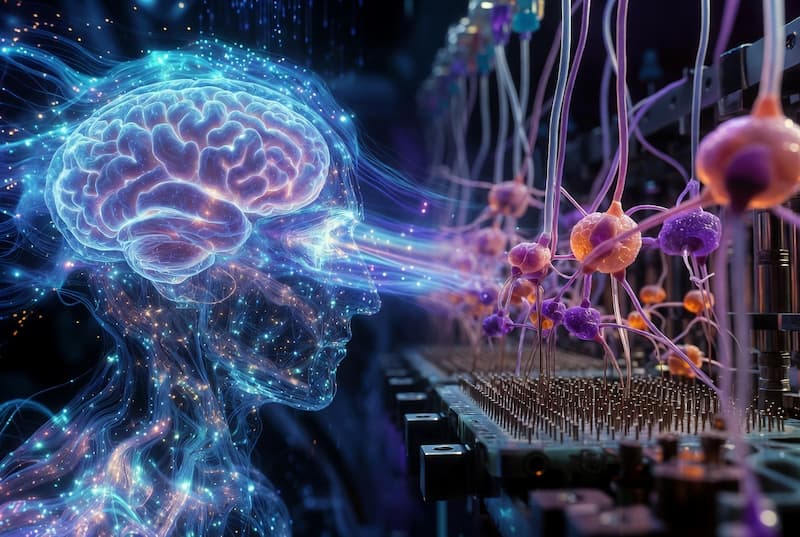
On March 26, 2026, Meta’s Fundamental AI Research (FAIR) team quietly released something that deserves far more attention from the biocomputing world than it has received. TRIBE v2 — the TRImodal Brain Encoder version 2 — is not a biocomputer. No living neurons are involved. No wetware. No perfusion systems. It runs entirely on silicon GPUs and predicts brain activity from fMRI scans at a resolution 70 times higher than its predecessor.
That distinction matters enormously. The biocomputing field has spent years arguing that living neurons are irreplaceable — that biological computation is fundamentally different from simulation. TRIBE v2 does not challenge that argument. What it does instead is something more immediately useful: it gives wetware researchers a virtual testbed to run thousands of experiments before a single neuron is plated on a chip.
The question worth asking is not whether TRIBE v2 is a biocomputer. It is whether TRIBE v2 could make real biocomputers — systems like Cortical Labs’ CL1 or FinalSpark’s Neuroplatform — arrive faster, work better, and cost less to iterate on.
The Distinction That Actually Matters — Simulation vs. Substrate
The biocomputing field carries a persistent confusion problem. Every time a new AI model is described as “brain-inspired” or “neuromorphic,” someone in the community has to stand up and explain why silicon approximations of neurons are not neurons. TRIBE v2 will inevitably be caught in that same conversation, so it’s worth being precise from the start.
TRIBE v2 is a brain encoding model. It takes a stimulus — a movie clip, an audio segment, a sentence — and predicts how specific voxels across the human cortex would activate if a real person were watching, listening, or reading. The prediction space covers 20,484 cortical vertices on the fsaverage5 mesh plus 8,802 subcortical voxels, totaling roughly 29,000 independent brain locations per time point. That is extraordinary spatial resolution for a computational model.
But the computation is happening on GPUs. LLaMA 3.2-3B is doing the language encoding. V-JEPA2 is processing video. Wav2Vec-BERT 2.0 is handling audio. A lightweight 8-layer Transformer integrates the three modalities and projects them onto predicted brain space. The biological substrate — the thing that makes CL1 meaningful — is entirely absent.
The CL1 runs on approximately 200,000 living human neurons grown from stem cells directly onto a silicon chip. Those neurons learn. They adapt in real time. They respond to electrical stimuli by reorganizing their own networks, a process called self-directed plasticity that no current AI model can replicate from first principles. When Cortical Labs’ Brett Kagan says the cells “taught themselves to play Pong,” he means they reorganized their own synaptic architecture in response to feedback — something TRIBE v2’s Transformer weights cannot do without a gradient update.
That is the fundamental substrate difference. One system computes about biology. The other computes with biology.
What TRIBE v2 Actually Built — Architecture and Scale
Setting aside the ontological debate, the technical achievement inside TRIBE v2 is significant enough to warrant serious attention on its own terms.
The original TRIBE model won first place at the Algonauts 2025 competition with a one-billion parameter architecture trained on four subjects. Version 2 is a different order of magnitude. Training data expanded to 451.6 hours of fMRI recordings from 25 subjects across four naturalistic paradigms: movies, podcasts, silent video, and audiobooks. Evaluation ran across 1,117.7 hours from 720 subjects. Total: more than 1,500 hours of human brain data fed into a single model.
The architecture stacks three frozen frontier encoders:
- Text: LLaMA 3.2-3B processes each word with 1,024 tokens of preceding context, then maps to a 2 Hz temporal grid
- Video: V-JEPA2-Giant processes 64-frame segments (the preceding four seconds) per time bin
- Audio: Wav2Vec-BERT 2.0 resampled to 2 Hz to match stimulus rate
Each modality’s embeddings compress to a shared dimension of 384, then concatenate to produce a 1,152-dimensional multimodal time series. An 8-layer, 8-head Transformer processes 100-second windows with learnable positional and subject embeddings — the subject embedding is what enables zero-shot generalization to new individuals the model has never seen.
The output: a subject-conditional linear layer that projects directly onto the high-resolution cortical surface and subcortical volume. No fine-tuning required for new subjects in zero-shot mode. With just one hour of data from a new participant and a single fine-tuning epoch, performance improves 2–4× over conventional linear baselines.
The scaling result is perhaps the most important finding: encoding accuracy increases log-linearly with training data volume, with no saturation yet observed. This is the same scaling law pattern found in large language models — suggesting that as neuroimaging repositories expand globally, models like TRIBE v2 will continue improving without architectural changes.
What TRIBE v2 Can Do That No Human Lab Can Match
The most underappreciated use case for TRIBE v2 is not prediction — it is virtual experimental design at scale.
Running a single fMRI session on one participant costs between $600 and $2,000 USD in scanner time alone, excluding participant fees, data analysis, and the months of preprocessing before results are usable. A typical neuroscience study runs 20–40 subjects. A well-powered experiment might take two years from design to publication. TRIBE v2 changes that economics completely.
Researchers can now submit a stimulus — any video, audio clip, or text passage — and receive a predicted whole-brain response across 720 virtual subjects in minutes. The group correlation on Human Connectome Project 7T data sits at R_group ≈ 0.4, which is approximately twice the accuracy of the median individual subject recording. In practical terms: TRIBE v2’s virtual cohort is a more reliable representation of average brain response than many real experimental samples.
The model’s in-silico validation capabilities are equally striking. When fed classic neuroscience paradigms without any specialized training, TRIBE v2 spontaneously recovers:
- The fusiform face area (FFA) — the cortical region that activates for faces
- The parahippocampal place area (PPA) — active for spatial scenes and buildings
- The temporo-parietal junction — associated with emotional and social processing
- Broca’s area — the classical syntax and language production region
- Five major functional networks via ICA on final-layer activations: auditory, language, motion, default mode, and visual
These were not targets the model was trained to find. They emerged from scale and architecture alone — which is exactly the kind of emergent validity that makes the model scientifically credible.
The Bridge to Real Biocomputers — Where TRIBE v2 Actually Changes the Game
Here is where TRIBE v2 becomes directly relevant to the wetware field.
Cortical Labs is currently operating a prototype Bio Data Centre in Melbourne with 120 CL1 units, each drawing approximately 30 watts and housing neurons kept alive for up to 500 days. A Singapore facility with 1,000 CL1 units is planned for September 2026. FinalSpark’s Neuroplatform offers remote access to human brain organoids starting at $1,000 per month. The computational substrate is real, living, and increasingly accessible.
The bottleneck is not hardware. The bottleneck is knowing what stimuli and protocols to send those neurons.
Each CL1 experiment consumes real biological resources: media replacements, electrode calibrations, tubing swaps every five to six months. Poorly designed experimental protocols waste irreplaceable tissue and weeks of researcher time. There is no “undo” when you’ve exposed 200,000 neurons to a suboptimal electrical stimulation pattern.
TRIBE v2 offers a solution: run the experiment virtually first. Design a stimulation protocol, predict how a biological neural network would respond to it using TRIBE v2’s cortical response model, identify the parameter ranges most likely to produce the target activation pattern, then run a focused, high-confidence experiment on the CL1. The iteration cost drops from weeks to hours. The tissue waste drops to near zero for the pre-screening phase.
This is the same logic that makes computational drug screening valuable before animal trials — not as a replacement for biology, but as a filter that makes every biological experiment more intentional. At BioComputer, we’d argue this is one of the most significant near-term acceleration mechanisms for the entire wetware field.
The Limits Nobody Is Talking About
TRIBE v2 has real constraints that deserve honest treatment.
fMRI temporal resolution is slow. The blood-oxygen-level-dependent (BOLD) signal that fMRI measures is a hemodynamic proxy for neural activity — a blurry, 1–2 second lag behind the actual electrical events happening in neurons. CL1’s sub-millisecond electrical feedback loops operate at a timescale roughly 1,000× faster than what TRIBE v2’s training data can capture. This means the model’s predictions are accurate for slow, sustained activation patterns but fundamentally cannot model the millisecond-scale spike dynamics that define how living neural networks actually compute.
Individual variability is a hard ceiling. The model’s subject embedding allows zero-shot generalization, but it does so by compressing individual differences into a low-dimensional vector. The true dimensionality of human neural variability — shaped by genetics, experience, attention state, emotional context — is far beyond what 720 subjects and 1,500 hours of data can fully characterize.
The model predicts responses, not computations. TRIBE v2 tells you which brain regions activate in response to a stimulus. It does not tell you what the brain is computing when those regions activate. For wetware researchers trying to design input-output protocols that train CL1 neurons to solve specific tasks, this is a meaningful gap. Knowing that area V5 activates for motion does not tell you what electrical signal pattern will teach neurons on a planar electrode array to detect motion.
These are not fatal limitations. They are calibration requirements — reminders that TRIBE v2 is a powerful telescope pointed at biology, not a replacement for standing on the ground.
An Open-Source Foundation for the Entire Field
Meta released TRIBE v2 under a CC BY-NC license on March 26, 2026. Model weights are available at HuggingFace. The complete training and inference codebase is on GitHub. An interactive demo at aidemos.atmeta.com/tribev2 lets any researcher upload video, audio, or text and watch the predicted brain response unfold in real time.
The CC BY-NC licensing makes TRIBE v2 freely usable for academic research — including by the organoid intelligence labs at Johns Hopkins, the BrainWare team at Indiana University, or any researcher working with FinalSpark’s Neuroplatform. The model’s log-linear scaling behavior means the community can contribute new fMRI datasets and directly improve the model’s predictive accuracy over time. This is, effectively, a public infrastructure project for computational neuroscience.
The Algonauts competition lineage matters here too. The original TRIBE architecture won first place at Algonauts 2025 — a benchmarked, peer-reviewed competition setting where its predictions were directly compared against other state-of-the-art encoding models. TRIBE v2’s improvements are not claims from a company press release. They are validated on the Human Connectome Project 7T dataset, one of the highest-quality neuroimaging collections in the world.
Biology Computes. Simulation Predicts. The Difference Is Everything.
The risk in covering TRIBE v2 for a biocomputing audience is that it gets filed in the wrong mental category. It is not a step toward simulating consciousness. It is not a threat to the wetware paradigm. It is a precision instrument for understanding how real biological tissue will respond to inputs we design — and that understanding has been the field’s most expensive bottleneck.
Cortical Labs’ neurons are learning to play Doom. They are doing it slowly, messily, with a lot of cell death along the way. Brett Kagan described them as “a beginner who’s never seen a computer.” What TRIBE v2 offers is a way to show those beginners what kinds of environments have been most legible to biological neural networks — across 720 real human subjects, across thousands of hours of naturalistic stimulation.
The biological revolution in computing will not be won by simulation. But it may be accelerated, significantly, by knowing exactly where to look first.
References
- Meta FAIR. (2026). A Foundation Model of Vision, Audition, and Language for In-Silico Neuroscience. Meta AI Research. https://ai.meta.com/research/publications/a-foundation-model-of-vision-audition-and-language-for-in-silico-neuroscience/
- MarkTechPost. (2026). Meta Releases TRIBE v2: A Brain Encoding Model That Predicts fMRI Responses Across Video, Audio, and Text Stimuli. https://www.marktechpost.com/2026/03/26/meta-releases-tribe-v2
- Cortical Labs. (2026). CL1 Biological Computer. https://corticallabs.com/cl1
- Information Age / ACS. (2026). This Melbourne data centre runs on human brain cells. https://ia.acs.org.au/article/2026/this-melbourne-data-centre-runs-on-human-brain-cells.html
- Cuthrell, S. (2025). Could This Biocomputer Revolutionize Neuroscience and Drug Discovery? IEEE Spectrum. https://spectrum.ieee.org/biological-computer-for-sale
- Digital Applied. (2026). Meta TRIBE v2: AI Brain Digital Twins Open-Sourced. https://www.digitalapplied.com/blog/meta-tribe-v2-ai-brain-digital-twins-guide
- Kagan, B. et al. (2022). In vitro neurons learn and exhibit sentience when embodied in a simulated game-world. Neuron. https://doi.org/10.1016/j.neuron.2022.09.001
Related: What Is a Biocomputer in 2026? · FinalSpark Neuroplatform · Cortical Labs CL1
Feature image: AI-generated using Grok.