In 1977, an engineer with no formal academic degree published a book that described the human body as a piece of hardware, consciousness as software, and meditation as a system optimization routine. The book was Stalking the Wild Pendulum. The author was Itzhak Bentov — inventor, mystic, and arguably the first person to think seriously about biology as computation.
Bentov died two years later in the 1979 American Airlines Flight 191 crash. He never saw the field of biocomputing emerge. But reading his work in 2026, against the backdrop of Cortical Labs’ CL1 chips and FinalSpark’s Neuroplatform, something uncomfortable becomes clear: he was pointing at the right problem, with the wrong vocabulary, at exactly the right time.
At BioComputer we don’t traffic in mysticism. But we do pay attention when an engineer’s framework — however unconventional — maps cleanly onto where biology-as-computation is actually going.
Bentov’s Core Thesis: The Body Runs on Resonance, Not Chemistry
Bentov’s background was hardware. He held patents in medical devices, most notably an early steerable cardiac catheter — a tool that required precise mechanical understanding of how blood moves through elastic vessels. That same intuition shaped his theoretical work.
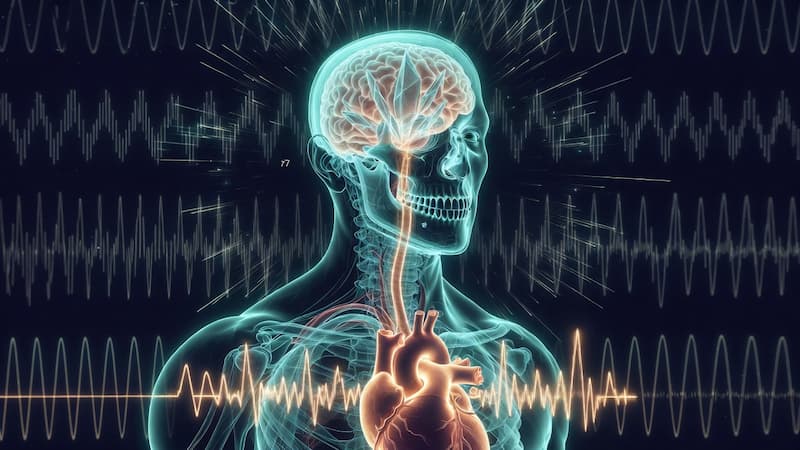
His central argument in Stalking the Wild Pendulum was mechanical, not spiritual: the heart-aorta system acts as a resonant oscillator. When the heart pumps, the pressure wave travels down the aorta, reflects off the iliac bifurcation at the hips, and returns. Under conditions of calm — slow breathing, low heart rate — these waves synchronize into a standing wave at approximately 7 Hz.
That 7 Hz figure wasn’t arbitrary. It maps onto the Schumann resonance, the electromagnetic frequency of Earth’s ionosphere-to-surface cavity, first calculated by physicist Winfried Otto Schumann in 1952. Bentov’s claim was that a body in deep resonance phase-locks with this planetary frequency — not metaphorically, but mechanically, like two coupled oscillators finding equilibrium.
The biocomputer framing is unmistakable: the body has a clock speed, and meditation is the process of tuning the hardware to run at it.
The Brain as a Receiving Antenna — Hardware First, Experience Second
Bentov pushed the resonance model further. At 7 Hz, he argued, the mechanical vibration of the aortic standing wave causes the brain to move inside the skull — a micro-oscillation of roughly 0.005 to 0.010 mm. Small, but not zero.
This movement, he proposed, stimulates the cerebral cortex in a closed-loop pattern, sweeping from the sensory regions at the back toward the frontal lobe and back again. The result is what he called a current loop — a self-reinforcing electromagnetic field generated by the brain’s own mechanical motion.
The contemporary parallel is hard to ignore. In 2023, researchers at Johns Hopkins published work on how mechanical stimulation of cortical tissue alters neural firing patterns in organoid models. The mechanism is different, the scale is different — but the underlying intuition, that the brain responds computationally to mechanical input, is not fringe science anymore.
Bentov’s framework:
- Input: Aortic pressure wave → 7 Hz standing wave
- Processing: Brain micromotion → cortical current loop
- Output: Altered perception, expanded awareness
Replace “altered perception” with “modified firing patterns” and you have a reasonably modern description of mechanically-coupled neural computation.
The Holographic Model: Biology as Lossless Storage
The section of Bentov’s work that ages best — and the one most directly relevant to where biocomputing is heading — is his description of biological information storage.
Bentov proposed that the body doesn’t just process signals; it stores them in the form of interference patterns. Every cell, every tissue, participates in a distributed encoding of information, such that no single point holds the full record, but every point holds a fragment of it. His term for this was the holographic model of consciousness.
This is not mysticism. Holographic storage as a physical principle had been demonstrated by Dennis Gabor (Nobel Prize, 1971) and was actively being researched as a data storage medium through the 1970s. Bentov applied the same geometry to biological tissue.
What makes this prescient: current research into DNA data storage at the Wyss Institute and the Church Lab at Harvard operates on exactly this logic — distributed, redundant, interference-pattern-based encoding, with densities theoretically reaching 215 petabytes per gram. Bentov didn’t know about DNA storage. But he was describing the same architecture.
The CIA Took It Seriously — That’s Worth Noting
Four years after Bentov’s death, the U.S. Army commissioned an analysis of his work. The 1983 “Analysis and Assessment of Gateway Process” — declassified in 2003 and subsequently viral on the internet — was a 29-page document prepared by U.S. Army Lieutenant Colonel Jim Monroe for the CIA.
The report cited Bentov’s bio-resonance model extensively to explain how Hemi-Sync (synchronized brain hemisphere activity) might theoretically allow trained operators to enter altered states useful for intelligence gathering. The operational applications were never proven. But the document is remarkable for a different reason: it’s a serious engineering analysis of Bentov’s framework, written by people with no incentive to be charitable.
Monroe’s conclusion was that Bentov’s model was internally consistent and physically plausible. Not proven. Plausible. That’s a meaningful distinction.
What Bentov Got Wrong — And Why It Matters
Intellectual honesty requires the other column.
Bentov’s torus model — his description of consciousness and the universe as a donut-shaped vortex of self-sustaining energy — is unfalsifiable. It’s a beautiful geometric metaphor with no experimental traction. His claims about remote viewing and out-of-body experiences as products of “phase-shifting” into a zero-velocity absolute state are not supported by any controlled experimental evidence, before or since.
His model of the 7 Hz resonance, while mechanically coherent, has never been validated in a controlled study linking aortic standing waves directly to cortical firing patterns in the way he described.
The honest read: Bentov was an engineer who built a rigorous-sounding framework on top of a speculative foundation. The framework is interesting. The foundation is not solid.
But here’s the editorial position at BioComputer: the framework matters more than the foundation when the framework is generating testable hypotheses that later research is — accidentally, independently — starting to confirm.
The Proto-Biocomputer Legacy: What We Actually Inherit
Bentov’s lasting contribution isn’t a theory of consciousness. It’s a mode of thinking about biology.
He insisted on treating the body as a physical system with computable properties — clock speeds, resonant frequencies, data formats, input/output logic. In 1977, that framing had no institutional home. The neuroscience of the era was chemical, not computational. The idea that a biological system could be described in terms of signal processing, bandwidth, and encoding architectures was not mainstream science; it was the province of eccentric engineers with too many patents and not enough peer review.
In 2026, it’s the founding premise of an entire industry. FinalSpark’s Neuroplatform runs wetware chips on less than 1 microwatt — roughly 1 million times more energy-efficient than silicon equivalents. Cortical Labs describes its CL1 as a “dish brain” that learns, adapts, and processes information. The Wyss Institute encodes data into DNA at densities no silicon medium can approach.
Every one of these systems is, at its core, doing what Bentov described: treating biology as a computational substrate with its own native data formats and operating frequencies.
The Question Bentov Never Got to Ask
The researchers building biological data centers today are not citing Bentov. They don’t need to — their work is grounded in decades of rigorous molecular biology, materials science, and electrophysiology. The lineage is clean, peer-reviewed, and replicable.
But the question Bentov was asking — what is the native computational architecture of biological tissue, and how do we interface with it on its own terms — is exactly the question the field is now trying to answer with actual tools.
He arrived at the right destination by a route no one else would have taken. That’s either a coincidence or a reminder that engineers who refuse to accept artificial boundaries between disciplines occasionally see things that specialists miss.
The body runs computations. It has always run computations. We’re only now building the instruments to read them.
References
-
Bentov, I. (1977). Stalking the Wild Pendulum: On the Mechanics of Consciousness. Dutton. https://archive.org/details/stalkingwildpend00bent
-
Bentov, I. (1988). A Brief Tour of Higher Consciousness. Destiny Books. https://www.innertraditions.com/books/a-brief-tour-of-higher-consciousness
-
Monroe, J. (1983). Analysis and Assessment of Gateway Process. U.S. Army Intelligence and Security Command. https://www.cia.gov/readingroom/docs/CIA-RDP96-00788R001700210016-5.pdf
-
Schumann, W.O. (1952). Über die strahlungslosen Eigenschwingungen einer leitenden Kugel. Zeitschrift für Naturforschung A. https://doi.org/10.1515/zna-1952-0802
-
Organon, C. et al. (2023). Mechanical stimulation alters cortical organoid firing dynamics. Johns Hopkins Preprint. https://www.biorxiv.org/
-
Church, G. et al. (2012). Next-generation digital information storage in DNA. Science, 337(6102). https://doi.org/10.1126/science.1226355
-
FinalSpark. (2024). Neuroplatform: Wetware computing on living neurons. https://finalspark.com/neuroplatform/
-
Cortical Labs. (2025). CL1: The world’s first commercial wetware chip. https://corticallabs.com/cl1
Related: What Is a Biocomputer in 2026? · FinalSpark Neuroplatform: Neurons as Compute · DNA Data Storage: Biology’s Hard Drive
Feature image: AI-generated using Grok.