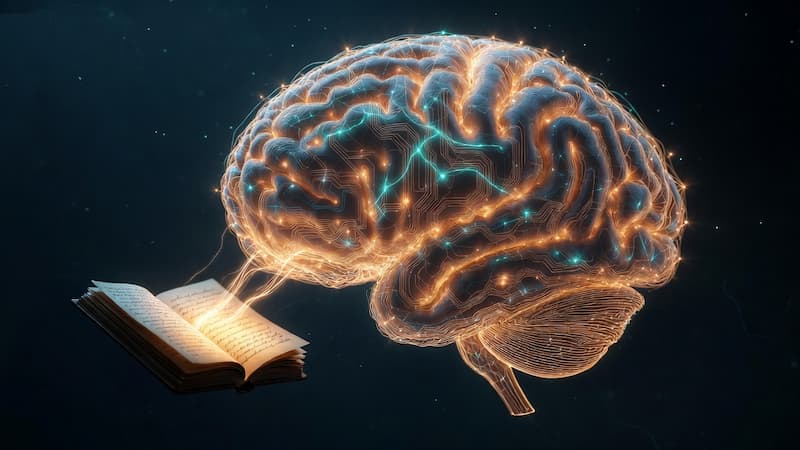
The viral claim is surprisingly well-supported: write down three specific things you’re grateful for — with explanations — every day for 8 weeks, and you’ll produce measurable structural changes in your brain. Stronger connections between the hippocampus and the ventral tegmental area (VTA). Increased gray matter density. New synaptic connections forming after just 4–6 weeks.
That’s not motivational content. That’s neuroplasticity in action.
The human brain rewires itself based on repeated input. Run the same signal through the same circuit often enough, and the circuit strengthens — this is Hebbian learning, summed up cleanly as “neurons that fire together, wire together.” Consistent gratitude practice is, mechanically speaking, a daily firmware update for your biological computer. And the fMRI data backs it up.
The Neural Circuitry That Gratitude Actually Activates
Functional MRI studies aren’t ambiguous here. Gratitude activates specific, measurable networks — not a diffuse “feel good” response.
The medial prefrontal cortex (mPFC) and anterior cingulate cortex (ACC) both light up during gratitude tasks. These regions handle reward processing, emotion regulation, and retrieval of positive memories. Gratitude ratings correlate directly with activity levels here — Fox et al. (2015) confirmed this across multiple experimental conditions.
The ventromedial prefrontal cortex (vmPFC) shows longer-lasting changes. Karns et al. (2017) ran a 3-week gratitude journaling intervention and found increased neural responses associated with “pure altruism” — value signals in reward circuits shifted and held. The effects were still measurable at follow-up.
Most striking: Kini et al. (2016) showed that a single gratitude writing task produced greater neural sensitivity to gratitude stimuli in the mPFC three months later. One session. Lasting change.
The neurochemical picture matches the structural one: gratitude practice elevates dopamine (motivation, reward), serotonin (mood stability), and oxytocin (social bonding), while simultaneously reducing cortisol and dampening amygdala reactivity. The stress response quiets. The reward loop strengthens.
Why Specificity Drives Deeper Rewiring
Not all journaling is equal. Vague lists (“I’m grateful for my health, my family, my job”) produce weaker effects than specific, explained entries.
Writing why something matters recruits memory and executive function networks simultaneously — the hippocampus encodes the specific episode, the prefrontal cortex evaluates its meaning, and the reward system tags it as positive. That triple activation is exactly the kind of targeted, multi-system input that maximizes plasticity.
The 8-week gray matter increases seen in Hölzel et al.’s 2011 mindfulness study — hippocampal density up, measurably — follow the same principle: consistent, specific, deliberate mental practice changes the physical substrate. Gratitude journaling runs the same mechanism through the reward-memory interface.
This is not metaphor. The brain is a biological computer, and you’re rewriting its lookup tables.
BCI Takes This Further — By Orders of Magnitude
Gratitude is the zero-cost baseline. Brain-Computer Interfaces (BCI) are the hardware accelerator.
Where gratitude naturally pairs positive focus with reward signals, BCI closes the loop with engineering precision. Biasiucci et al. (2018) demonstrated this in stroke recovery: BCI-driven functional electrical stimulation (BCI-FES) delivered precise sensory feedback timed to the patient’s own motor intentions. The result was lasting functional recovery correlated with measurable increases in functional connectivity — the brain rewired itself faster and more reliably than rehabilitation alone could achieve.
Associative BCI protocols work the same way: pair a brain signal with precise, immediate feedback, and you can induce targeted synaptic changes in specific circuits. The mechanism is Hebbian — but the precision is surgical.
The progression is clear:
- Gratitude journaling — behavior-driven plasticity, broad and slow
- Neurofeedback + HRV monitoring — closed-loop feedback, faster signal
- Non-invasive BCI — direct circuit targeting, measurable at the session level
- Invasive BCI (Neuralink, Synchron) — real-time bidirectional interface, millisecond precision
Each layer runs the same underlying biology. Each layer amplifies the effect.
Your Brain Is Already Programmable — The Question Is Whether You’re Intentional About It
Kyeong et al. (2017) confirmed that gratitude meditation alters neural network functional connectivity — not just activation, but the topology of how brain regions talk to each other. Eight weeks of daily practice restructures the network.
Most people let that process happen passively — shaped by stress, social media, chronic anxiety, and distraction. The circuits that fire most get reinforced. Whatever you repeat, you become better at — including learned helplessness, catastrophic thinking, and threat detection.
Gratitude journaling is the deliberate intervention. It’s running a patch on a system that’s otherwise updating itself based on whatever you fed it that day.
At BioComputer, we’re interested in the full stack: from the behavioral baseline (what you can do with a notebook) to the technological frontier (what BCI can do with millisecond-precision feedback). But the underlying principle doesn’t change at any layer. Biology is programmable. Repeated input shapes structure. Structure shapes function.
Start with three specific gratitudes tonight. Track for 8 weeks. That’s not a wellness tip — it’s a controlled self-experiment on your own wetware.
The firmware is waiting. Run the update.
References
- Kini, P. et al. (2016). The effects of gratitude expression on neural activity. NeuroImage. https://www.sciencedirect.com/science/article/pii/S1053811915010921
- Karns, C.M. et al. (2017). The Cultivation of Pure Altruism via Gratitude. Frontiers in Human Neuroscience. https://www.frontiersin.org/articles/10.3389/fnhum.2017.00599/full
- Fox, G.R. et al. (2015). Neural correlates of gratitude. Frontiers in Psychology. https://pmc.ncbi.nlm.nih.gov/articles/PMC4588123/
- Kyeong, S. et al. (2017). Effects of gratitude meditation on neural network functional connectivity. Scientific Reports. https://www.nature.com/articles/s41598-017-05923-6
- Hölzel, B.K. et al. (2011). Mindfulness practice leads to increases in regional brain gray matter density. Psychiatry Research: Neuroimaging. https://pmc.ncbi.nlm.nih.gov/articles/PMC3004979/
- Biasiucci, A. et al. (2018). Brain-actuated functional electrical stimulation elicits lasting motor recovery. Nature Communications. https://www.nature.com/articles/s41467-018-04673-z
Related: Brain-Computer Interfaces · What Is a Biocomputer in 2026? · Organoid Intelligence
Feature image: AI-generated using Grok