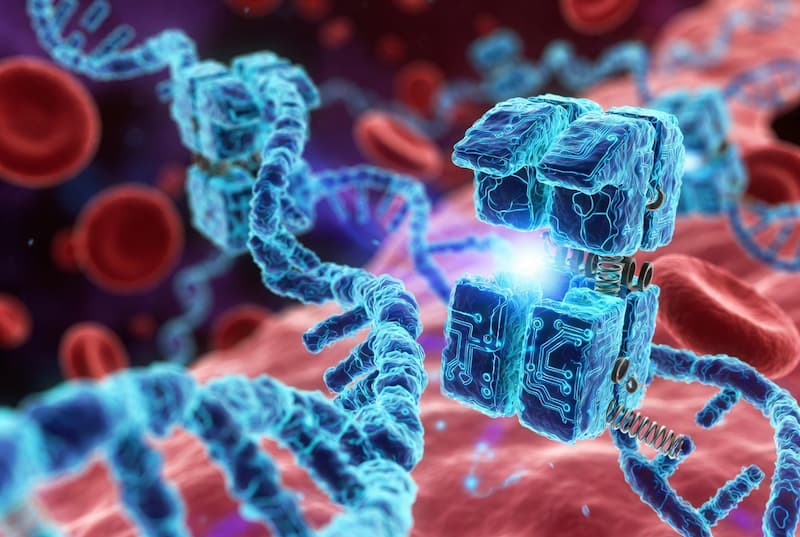
In 2025, a team spanning Ludwig-Maximilians-Universität München, Emory University, and Georgia Tech published something that quietly redrew the boundaries of what “computer” can mean. Their spring-loaded DNA origami arrays — published in Science Robotics — didn’t just carry a payload. They stored energy, processed multiple molecular signals, and executed multistep tasks without any external controller. The machine was the biology. The biology was the machine.
This is DNA origami nanorobotics: the art of folding long DNA scaffolds into precise 3D structures using hundreds of short “staple” strands, then programming those structures to behave like autonomous decision-making systems at the nanoscale. The shapes range from hollow barrels to spring-loaded hinges, and the logic runs on strand displacement reactions — the same base-pairing rules that have governed genetic information for billions of years.
The hard question isn’t whether these nanorobots work. The 2025–2026 literature confirms they do. The question is what it means when the most sophisticated computers on Earth are made of the same material as your chromosomes — and they swim in your veins.
Folding DNA Into Hardware — Not Metaphor, Literal Hardware
DNA origami was pioneered by Paul Rothemund at Caltech in 2006, but the 2025 generation bears little resemblance to his flat 2D smiley face. Today’s constructs are fully 3D, dynamically reconfigurable, and functionally programmable in a sense that would have seemed implausible a decade ago.
The scaffold is typically a long single-stranded DNA derived from the M13 bacteriophage — roughly 7,000–8,000 nucleotides. Hundreds of short staple strands fold it into whatever geometry the designer specifies: tubes, barrels, hinges, cages. The precision is sub-nanometer. A folded DNA origami structure is roughly 10–100 nm across — small enough to enter cells, pass through capillaries, and interact directly with molecular machinery.
What makes this “hardware” rather than just “structure” is the integration of logic. Strand displacement reactions allow specific input sequences to trigger conformational changes, release tethered molecules, or activate cascades. Stack enough of these together and you have Boolean gates. Stack more and you approach the complexity of a multi-step program — one that runs entirely on chemical energy with no battery, no external signal, no silicon.
The Ludwig-Maximilians team’s 2025 Science Robotics paper operationalized this fully: their arrays treated each origami junction as an independent computational unit capable of storing energy and executing tasks in sequence. It’s modular wetware architecture — and it scales.
The Computation Model: Logic Gates Made of Base Pairs
Classical computers process information by switching transistors between 0 and 1. DNA nanorobots process information by switching molecular conformations between states — open/closed, active/inactive, released/sequestered.
Strand displacement is the core operation. A toehold sequence on one strand binds an incoming complementary strand, which then displaces the existing strand through branch migration. The result: a new molecular state. Chain enough displacements and you have AND gates, OR gates, and threshold logic — all without any protein, enzyme, or external energy source beyond the base-pairing free energy.
Researchers have demonstrated neural-network-like behaviors using DNA strand displacement cascades, where the system learns to classify molecular patterns. This isn’t metaphorical AI — it’s a literal implementation of weighted computation in wet chemistry. The 2025 work from Stuttgart showed a complementary capability: using DNA origami to control the shape and permeability of lipid vesicles, essentially programming synthetic membranes to open transport channels on command.
What emerges from combining logic + actuation is something genuinely new: a molecular robot that computes its own decision to act, then acts, without any biological or electronic intermediary.
Targeted Delivery Is the Near-Term Killer App — With Real Caveats
The most clinically advanced application is targeted drug delivery, specifically in oncology. The foundational mouse study — thrombin-loaded DNA nanorobots that selectively cut off tumor blood supply — dates to 2018. By 2025, the field had moved to oligonucleotide drug carriers with integrated computation: nanorobots that only release their payload when they detect a specific combination of tumor surface markers.
The logic gate model here is medically precise. A cancer cell expressing antigen A and protein B triggers release; a healthy cell expressing only A does not. This AND-gate selectivity is the key differentiator from conventional chemotherapy, which cannot distinguish at the molecular level. Abdollahzadeh et al.’s 2025 review in Advanced Drug Delivery Reviews documents the current state of these oligonucleotide carrier platforms in detail.
Some reports have mentioned expectations of human trials beginning around 2026. These need context: as of early 2026, DNA origami therapeutics remain preclinical or early-stage. Mouse data is promising. Human pharmacokinetics, immune response, and manufacturing scale are different problems entirely — ones the field is actively working through, not ones it has solved.
The honest timeline: this is a decade-scale transition, not a year-scale one. But the trajectory is real.
Three Unsolved Problems That Actually Matter
Progress is genuine. So are the obstacles. Three problems define the ceiling:
- Manufacturing consistency. Producing DNA origami structures at pharmaceutical scale — with controlled folding, minimal mis-folding, and batch-to-batch reproducibility — remains expensive and technically demanding. The synthesis of thousands of unique staple strands per design is not trivial.
- In vivo stability. DNA degrades. Nucleases in blood and tissue chew unprotected strands within minutes. Current solutions include chemical modifications (PEG coating, phosphorothioate backbones) and encapsulation strategies, but durability in complex human physiology at therapeutic doses is unproven at scale.
- Immune recognition. Foreign DNA can trigger innate immune responses. The Toll-like receptor pathways that evolved to detect bacterial DNA don’t always distinguish “threat” from “therapeutic.” Minimizing immunogenicity while maintaining structural function is an active design challenge.
These aren’t reasons for pessimism. They’re engineering problems with clear research programs behind them. But anyone claiming clinical deployment is imminent is ahead of the data.
What This Means for the Programmable Biology Thesis
DNA origami nanorobots are the cleanest possible expression of the core biocomputing premise: biology as computation, running on wet chemistry, with no silicon required. They compute. They actuate. They degrade into harmless nucleotides. They fit through capillaries. They operate at the scale where cellular decisions are actually made.
At BioComputer, we track the wetware-to-infrastructure spectrum — from single-neuron processors to biological data centers. DNA nanorobots sit at the molecular end of that spectrum, but the design principles are identical to what makes organoid intelligence compelling: repurposing biology’s own information-processing mechanisms for engineered computation.
The question isn’t whether molecular biocomputers will work. The 2025 Science Robotics paper and the Stuttgart membrane work confirm the architecture is sound. The question is how fast the gap closes between “works in a lab dish” and “works reliably in a living patient.”
That gap is narrowing. And when it closes, the most powerful computers on the planet won’t be in a data center — they’ll be in the bloodstream, running on chemistry that evolution spent four billion years perfecting.
References
- Pfeiffer, F. et al. (2025). Spring-loaded DNA origami arrays as energy-supplied hardware for modular nanorobots. Science Robotics. https://www.science.org/doi/10.1126/scirobotics.adu3679
- Abdollahzadeh, I. et al. (2025). DNA nanotechnology in oligonucleotide drug delivery systems. Advanced Drug Delivery Reviews. https://www.sciencedirect.com/science/article/pii/S0169409X25001930
- Allard, J. (2025). Executing multistep tasks with DNA origami nanorobots. Nature Reviews Materials. https://www.nature.com/articles/s41578-025-00783-z
- University of Stuttgart. (2025). DNA origami nanorobots alter artificial cells. Phys.org. https://phys.org/news/2025-03-dna-nanorobots-artificial-cells.html
- Rothemund, P.W.K. (2006). Folding DNA to create nanoscale shapes and patterns. Nature, 440, 297–302. https://www.nature.com/articles/nature04586
Related: What Is a Biocomputer in 2026? · Programmable Biology: When Cells Become Living Software · Biohybrid Robots: When Machines Grow Their Own Muscles
Feature image: AI-generated using Grok