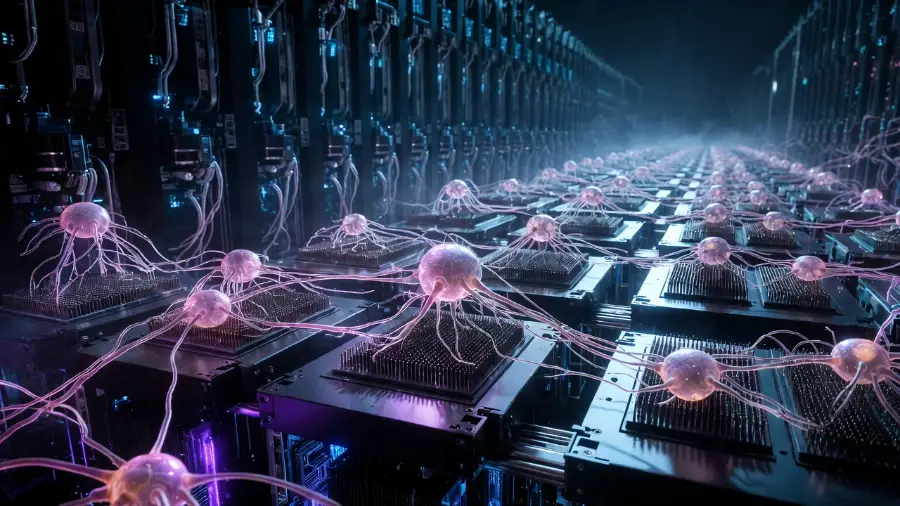
Cortical Labs and FinalSpark are no longer just lab experiments — they are the two commercial biocomputers you can actually use today.
Recent posts here already covered the DOOM breakthrough, the new biological data centers, and the ability to rent living neurons from anywhere. Now let’s put them side-by-side.
Specs at a Glance
| Feature | Cortical Labs CL1 | FinalSpark Neuroplatform |
|---|---|---|
| Neurons per unit | 200,000–800,000 (configurable) | 160,000 (16 organoids) |
| Access model | Buy $35,000/unit or cloud subscription | $500/month (commercial); free for academics |
| Power per unit | 30 watts | Claims ~1 million times more efficient than silicon |
| Location | Physical device (or cloud via Cortical Cloud) | Pure cloud — no hardware needed |
| Longevity | Up to 6 months | 100+ days (roadmap to 200+) |
| Best for | Edge devices, data centers, custom hardware | Rapid experimentation, no lab required |
| API | Python (Cortical Cloud) | Python + Jupyter Notebooks |
When to Choose Cortical Labs CL1
If your goal is infrastructure, the CL1 biocomputer is the only serious option on the market.
- You want to run biological data centers — Melbourne’s proof-of-concept with 120 units is already live, and a Singapore pilot is scaling to 1,000.
- You need physical hardware for robotics, edge AI, or environments where cloud latency is unacceptable.
- You’re prepared to invest $35,000 or more per unit upfront, or commit to a Cortical Cloud subscription.
The DOOM experiment proved that non-experts can train these neurons in under a week using the same Python API available through cloud access. The technical barrier is lower than it looks. The capital barrier is the actual constraint.
For Asia-based teams, the timing of the Singapore data center rollout in early 2026 makes the CL1 biocomputer specifically relevant right now.
When to Choose FinalSpark Neuroplatform
If your goal is research, prototyping, or simply understanding what a biocomputer can do before committing — FinalSpark is the on-ramp.
- You want to experiment today without buying hardware or running a wet lab.
- You need real-time stimulation control — dopamine, glutamate, microfluidic pumps, cameras, UV — all accessible remotely.
- Budget is the constraint — $500/month gives you full commercial access. Academic access is free.
The Neuroplatform proposition is straightforward: run experiments on living human brain cells, from anywhere in the world, with a laptop and a Python script. In 2026, that is a real product, not a pitch deck.
The Verdict in March 2026
Researchers and quick prototyping → FinalSpark wins.
No hardware to procure, no wet lab to run, no $35k decision to justify. If you want hands-on experience with a working biocomputer before making larger bets, FinalSpark is where to start.
Companies building production infrastructure → Cortical Labs.
The CL1 biocomputer is the only platform with a proven path from research bench to production rack. The Singapore data center rollout is the clearest signal that biological computing is entering the infrastructure phase, not just the research phase.
Both biocomputers are dramatically more energy-efficient than comparable GPU workloads. Both platforms are still early. But one of them will almost certainly power the first commercial bio-AI application within 18 months — and right now, the smart money is watching both.
Related: What Is a Biocomputer? · FinalSpark: Rent Living Neurons for $500/Month · 200,000 Brain Cells Just Learned to Play DOOM