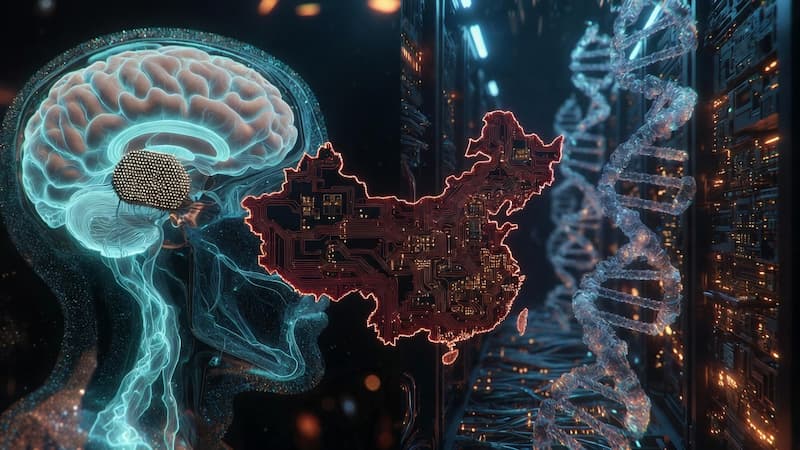
In March 2026, China’s National Medical Products Administration did something no regulatory body had done before: it approved an invasive brain-computer interface for commercial sale. Not a clinical trial. Not a compassionate use exemption. A product. On the market. Now.
The device — from Neuracle Medical Technology in Shanghai — lets patients with tetraplegia regain hand motor function through a fully wireless, AI-decoded implant system. The West is still debating the ethics. China shipped the product.
This is the carbon era. And China just declared it open for business.
The 15th Five-Year Plan Made This Inevitable
Brain-Computer Interfaces and Biocomputing are not fringe bets in China’s 2026–2030 national strategy — they are formally designated “Future Industries,” sitting alongside quantum computing and next-generation aerospace in the 15th Five-Year Plan. That designation unlocks state capital, regulatory fast-tracking, and clinical priority that no private company in the West can match.
Beijing’s Haidian District alone now houses over 27 core BCI companies in what has become, without exaggeration, the Silicon Valley of the brain. The infrastructure — incubators, clinical networks, manufacturing pipelines — was built deliberately over a decade. The NMPA approval in March 2026 was not a surprise to anyone watching. It was the scheduled outcome of a long-running state project.
China’s model here is “State-Led, Market-Driven”: the government sets the trajectory and absorbs the early risk; private companies race to capture the commercial upside. It is a playbook that built China’s EV industry. Now it is being applied to neural interfaces.
Neuracle and Beinao — Two Products, One Message
The Neuracle implant is a complete commercial package: wireless power, AI-driven signal decoding, a clinical support ecosystem. It is not a proof-of-concept. Neuracle engineered the full stack, not just the electrode array.
At the 2026 Zhongguancun Forum, the Beinao-1 system demonstrated successful outcomes in seven human subjects — restored speech and motor control via neural-digital throughput. Beinao-2 is already in clinical trials, targeting higher bandwidth. The pace is not iterative. It is aggressive.
What makes the Chinese BCI push distinct from Neuralink’s VOICE trial or Synchron’s Stentrode work in the US is the vertical integration. Chinese AI models trained on datasets from a population of 1.4 billion are already cutting BCI user training time from weeks to minutes. The feedback loop between neural data, model training, and device iteration is faster than anything operating in a fragmented Western regulatory environment.
BGI Is Turning DNA Into Infrastructure
Away from the brain, BGI-Research is quietly redefining what a data center can be made of. In early 2026, the group demonstrated a DNA-based storage platform capable of holding exabytes of data at 90% lower energy consumption than conventional server farms. This is not a lab curiosity — it is being framed as a component of China’s national green data center strategy.
DNA data storage works by encoding binary data into sequences of nucleotide bases — A, T, G, C — then synthesizing and reading those sequences on demand. The density is extraordinary: a single gram of DNA can theoretically store 215 petabytes. The challenge has always been read/write speed and error rates. BGI’s 2026 white paper claims meaningful progress on both fronts through AI-assisted error correction.
Alongside storage, China’s “AI Plus” initiative is funding synthetic biology labs to build biological circuits — cells engineered to perform AND, OR, and NOT logic operations. The long-term vision: biocomputers that diagnose and treat disease from inside the body, no silicon required. That is not science fiction in 2026. It is a funded research program with clinical ambitions.
The Integration Layer Nobody Is Talking About
The individual advances — Neuracle’s implant, Beinao’s bandwidth gains, BGI’s DNA storage — matter less than how China is combining them.
Bio-manufacturing infrastructure originally built for vaccine production is being repurposed to fabricate biological computer components at scale, driving down startup costs for the entire sector. AI models trained on neural signal datasets are being adapted for biological circuit design. The National AI Plus Strategy is the connective tissue that ties BCI, biocomputing, and synthetic biology into a single vertically integrated industrial ecosystem.
This is where the strategic gap with the West becomes visible. The US and EU have world-class research in each of these domains individually. What they lack is a single coordinating mechanism that moves discoveries from lab to infrastructure to market at national scale. China has that mechanism. It is called the Five-Year Plan.
Neural Privacy Is the Friction Point — And Beijing Knows It
The speed of commercialization has not come without pressure. As BCI applications begin moving beyond medical use into education and consumer gaming, neural privacy has become a live political issue. What happens when an employer can infer cognitive states from a BCI device? When a government can mandate neural data collection?
China’s response has been draft regulations on “Biosecurity and Neuroethics” — framed primarily around national security and data sovereignty rather than individual rights. The regulations protect Chinese neural data from foreign access more than they protect individual citizens from state access. That distinction matters enormously to how this technology will be governed globally.
The rest of the world needs to watch this carefully. The regulatory frameworks being written in Beijing in 2026 will become reference points — and points of contention — for every BCI deployment that follows.
The Race Is Not About Silicon Anymore
The transistor defined the 20th century’s compute wars. The neuron may define the 21st’s. China’s carbon era strategy is the most systematic national attempt to make biological systems — brains, DNA, engineered cells — the substrate of the next computing paradigm.
Whether that bet pays off in 10 years or 30, the infrastructure being built now will be extraordinarily difficult to replicate. The question is not whether biology will replace silicon. The question is who controls the biology when it does.
References
- National Medical Products Administration (NMPA). (2026). Approval Guidelines for Implantable Neural Interface Systems. https://www.nmpa.gov.cn/
- CGTN Tech News. (2026). China approves world’s first invasive BCI medical device for commercial launch. https://news.cgtn.com/
- BGI-Research. (2026, February). Integrating DNA Data Storage into National Green Data Center Strategies [White Paper]. https://www.bgi.com/
- National Development and Reform Commission. (2026). The 15th Five-Year Plan (2026–2030): Strategic Development of Future Industries and Multimodal Intelligence. https://www.ndrc.gov.cn/
- Xinhua News. (2026, March). Beinao-1 and the Future of Neuro-rehabilitation at Zhongguancun Forum. https://www.xinhuanet.com/
Related: What Is a Biocomputer in 2026? · Biological Data Centers: Can Wetware Solve AI’s Energy Crisis? · Brain-Computer Interfaces: The Clinical Frontier
Feature image: AI-generated using Grok