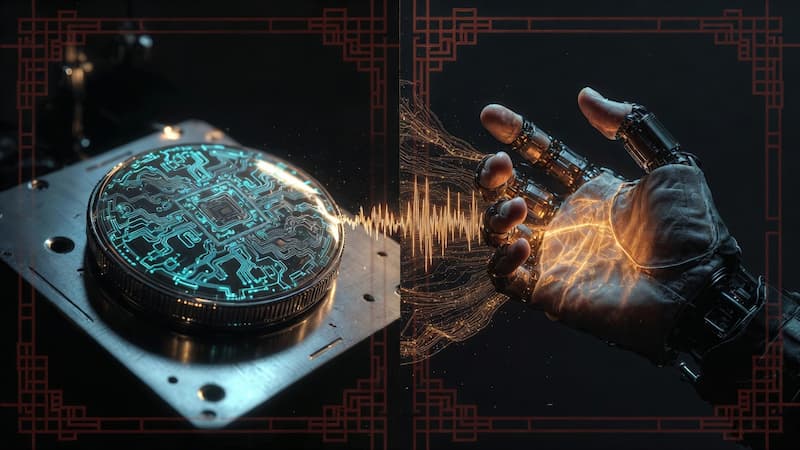
On March 13, 2026, China’s National Medical Products Administration granted the world’s first commercial approval for an invasive brain-computer interface. The device is called NEO — a coin-sized wireless implant developed by Shanghai-based Neuracle Medical Technology in collaboration with Tsinghua University, placed epidurally on the brain’s outer membrane. When a patient imagines moving their hand, NEO reads the motor cortex signal and wirelessly drives a soft robotic glove to grasp, hold, and manipulate objects. Target users: adults aged 18–60 with partial paralysis from cervical spinal cord injuries.
This is not a clinical trial. NEO is a commercial medical product — cleared for sale, surgical implantation, and real-world clinical use in Chinese hospitals today.
In one regulatory stroke, BCIs moved from experimental labs into everyday medicine. The brain-as-computer era has officially begun — and China fired the starting gun.
The Sputnik Signal Nobody Should Ignore
BCI has been formally designated a “future industry” in Beijing’s 2026–2030 five-year plan, alongside quantum computing, embodied AI, and 6G. The national roadmap is explicit: major technical breakthroughs by 2027, globally competitive companies by 2030, and widespread practical BCI deployment potentially within 3–5 years.
The policy response to NEO’s approval was immediate. Within one week of market authorization, China’s National Healthcare Security Administration completed medical insurance coding for the device — reviewing technical details, clinical scenarios, and industry needs at speed that no Western regulatory body has matched. That’s the difference between a government treating BCI as a priority and one treating it as a process.
Meanwhile, the US ecosystem remains largely in the trial phase. Neuralink has implanted its device in 21 human participants as of early 2026, with thousands of combined usage hours, and has publicly committed to high-volume, nearly fully automated surgical procedures in 2026. Paradromics received FDA Investigational Device Exemption approval for its high-bandwidth Connexus speech-restoration system, with first surgeries anticipated this year. Precision Neuroscience continues advancing thinner, less invasive cortical arrays. None have reached commercial clearance.
Chinese experts themselves acknowledge a current technological lag — particularly in high-channel-count penetrating implants. NEO places electrodes between the skull and dura mater rather than penetrating brain tissue directly, which is why it cleared faster but also why its signal resolution sits below Neuralink’s. But the regulatory and deployment lead gives China something more valuable than a lab benchmark: real-world data, at scale, from everyday clinical use.
NEO Is Just the Beginning — Meet the Rest of the Field
What makes China’s position formidable isn’t one approved device. It’s the depth of the pipeline behind it.
At the 2026 Zhongguancun Forum in Beijing, held just two weeks after NEO’s approval, a full exhibition of domestically developed BCI systems drew large crowds. Two systems attracted particular attention: Beinao-1 and Beinao-2. Beinao-1, a semi-invasive system, has already been implanted in seven patients — all of whom recovered well and regained both movement and speech function.
The active players span every approach in the field:
- NeuroXess — implantable flexible electrode interfaces
- NeuralMatrix — neuromorphic chip development
- BrainCo — noninvasive BCIs and bionic limbs, with a Hong Kong IPO filing underway after raising $287 million
- Neuracle — the NEO developer, now the global commercial benchmark
- Zhiran Medical, Aoyi Tech, Bo Rui Kang Tech — specialized clinical and rehabilitation systems
Provinces including Sichuan, Hubei, and Zhejiang have already set medical service pricing for BCI, accelerating its inclusion in the national insurance system. BCI clinics and clinical research wards now operate in Beijing, Tianjin, Guangzhou, Wuhan, and Nanjing.
This is not a startup ecosystem hoping for approval someday. This is an industry already treating patients.
Why Commercial Deployment Is the Real Advantage
The data flywheel is the mechanism everyone underestimates. Once thousands of patients use NEO daily, Neuracle accumulates longitudinal neural signal data that no trial cohort of 21 participants can replicate. Signal decoding improves. Biocompatibility issues surface and get fixed. Wireless power and algorithm efficiency compound over real use cases, not controlled sessions.
China’s December 2025 announcement of an 11.6 billion yuan ($165 million) brain science fund to support BCI companies from research through commercialization ensures the pipeline stays full. CCID Consulting projects China’s BCI market growing at 20% annually between 2024 and 2028 — outpacing most traditional manufacturing sectors — with the domestic market potentially exceeding 120 billion yuan (~$17 billion) by 2040.
First-mover advantage in hardware-dependent biological systems is brutal and durable. The nation that generates the most real-world neural interface data over the next three years will define the decoding standards, safety benchmarks, and performance baselines that the rest of the world writes regulations around.
Biocomputing Is the Actual Prize
Zoom out from the clinical application and the strategic stakes become clearer. Biocomputing — the deep integration of biological neural systems with computational hardware — is the next computing paradigm after silicon hits its physical and energy ceiling.
When thousands of human brains interface daily with silicon devices, the boundary between biological wetware and digital hardware doesn’t just blur — it becomes a research pipeline. Every NEO implantation generates data directly relevant to:
- Higher-bandwidth brain-machine symbiosis
- Thought-to-action at conversational speeds
- Sensory restoration — vision (Blindsight-style cortical stimulation), hearing, proprioception
- Hybrid architectures combining human neurons, organoid processors, DNA computing layers, and silicon
Ming Dong, vice president of Tianjin University, said it plainly at the ZGC Forum: China has already entered the first tier of global BCI development, with non-invasive technologies reaching parity with international standards and the gap in invasive systems narrowing rapidly. The nation that normalizes clinical BCI first will attract the neuroscientists, synthetic biologists, materials engineers, and AI researchers building all of it. Talent follows deployment. Capital follows talent. Ecosystems follow capital.
What the US Must Do — Not Eventually, Now
This is not panic. It’s pattern recognition from every major technology race in history: space, semiconductors, AI chips. The window for American leadership in biocomputing is narrowing, and the response needs to match the moment.
Four moves matter most:
- A BCI-specific regulatory fast-track — rigorous safety standards, dramatically shorter timelines. FDA’s current pathway was not designed for the pace of this field.
- A national biocomputing initiative — coordinating NIH, NSF, DARPA, and private industry around hybrid neural-silicon systems, organoid computing, and DNA architectures as a unified program, not scattered grants.
- Manufacturing scale — public support for high-volume, automated implant production so the US can deploy at clinical scale without quality tradeoffs.
- Aggressive talent policy — research grants, dedicated university programs, and immigration pathways to keep the world’s best minds building in America.
The US has unmatched innovation density, a mature ethical-regulatory framework, and entrepreneurial infrastructure that China cannot replicate quickly. Those are genuine advantages — but only if activated at the speed this moment demands.
The Brain-Computer Era Does Not Wait
Healthy global competition accelerates everything: faster innovation, richer safety datasets, broader patient access. That’s good for humanity. But competition requires competitors willing to compete.
China’s NEO approval isn’t a singular event — it’s the public face of a coordinated national push involving dozens of companies, multiple government ministries, hospital networks across six major cities, and a $165 million dedicated funding pool. The biological computation era is not a 2035 scenario. It is a 2026 market.
The fuse is lit. America’s move.
References
- Reardon, S. (2026, March 16). China approves brain chip to treat paralysis — a world first. Nature. https://www.nature.com/articles/d41586-026-00849-6
- ECNS / Chinanews. (2026, March 31). China leads the world in invasive BCI products. https://www.ecns.cn/china/2026-03-31/detail-ihfcexut9132033.shtml
- Reuters. (2026, March 8). China could see widespread use of brain-computer tech in 3–5 years. https://www.reuters.com/technology/china-brain-computer-interface-2026/
- TechCrunch. (2026, February 22). China’s brain-computer interface industry is racing ahead. https://techcrunch.com/2026/02/22/chinas-brain-computer-interface-industry-is-racing-ahead/
- Xinhua / CCTV. (2026, March 28). China’s BCI development shifts into high gear — ZGC Forum 2026. https://english.news.cn/20260328/514d1649035b4af88c84d0add1d36372/c.html
- Bloomberg. (2026, March 13). China approves first brain implant for commercial use. https://www.bloomberg.com/news/articles/2026-03-13/china-approves-first-brain-implant-for-commercial-use
- Paradromics. (2025–2026). FDA IDE approval for Connexus speech-restoration trials. https://paradromics.com/connexus
Related: What Is a Biocomputer in 2026? · Neuralink’s VOICE Trial: What It Means for BCIs · Organoid Intelligence: The Brain in a Dish
Feature image: AI-generated using Grok