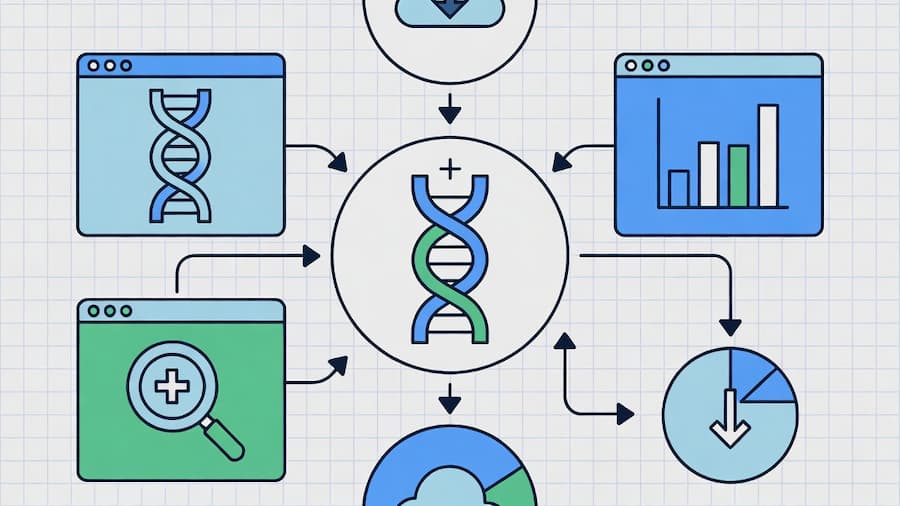
For decades, bioinformatics lived in the background — a support discipline that helped biologists manage data. In 2026, that story is over. The biocomputer era of biology is here, and it is moving fast.
From Pilot to Production
The shift happening right now isn’t subtle. Organizations that spent the last few years running AI experiments have crossed a threshold: they are now building production-ready, AI-native systems that sit at the core of R&D workflows. Industry analysts call it the “builder phase,” and the numbers back it up.
The global bioinformatics market reached $16.66 billion in 2024 and is expected to surpass $52 billion by 2034 — a trajectory that is accelerating, not slowing. Several drug candidates discovered and optimized by AI are now reaching mid-to-late-stage clinical trials, marking a decisive shift from computational promise to tangible medical results.
This is what a biocomputer revolution actually looks like: not a single dramatic announcement, but an entire industry quietly rewiring itself around biological computation.
The Death of the Wet-Lab-First Mentality
Traditional drug discovery started in the lab — hypothesize, pipette, fail, repeat. AI is inverting that process. Early target selection now relies heavily on in silico exploration of vast biological datasets before any researcher touches a test tube. The result: faster timelines, fewer expensive dead ends, and a fundamentally different relationship between computation and biology.
Tools like Bionl.AI are emblematic of this shift — no-code generative AI workspaces that compress complex multi-omics analysis from days to minutes using plain language queries. The biocomputer sitting in a researcher’s browser is now more powerful than entire computational departments from a decade ago.
80% of biotech organizations plan to ramp up AI spending in the near term, with many expecting to double their investment. This isn’t enthusiasm — it’s urgency.
AlphaFold Was Just the Beginning
If AlphaFold was the “moon landing” moment for structural biology, what’s happening now is the colonization. Scientists have used AI-assisted design to produce artificial genes that can be expressed in mammalian cells — and for the first time, an AI program was used to create an entirely synthetic virus.
New models like EnzymeCAGE use geometric deep learning to accurately predict the functions of uncharacterized enzymes and reconstruct biosynthetic pathways that were previously invisible to researchers. Protein design success rates have reached as high as 92% in benchmark studies.
Generative biology — using AI to design biological components from scratch — is moving from academic curiosity to active research frontier. The implications for synthetic biology, drug discovery, and even biosecurity are profound.
The Multiomics Moment
One of the most important trends is almost invisible to outsiders: the integration of multiomics data. Genomics, transcriptomics, proteomics, metabolomics, and spatial biology are no longer analyzed in silos. AI is the connective tissue that makes these heterogeneous datasets speak to each other — simulating cellular behavior, uncovering hidden disease mechanisms, and improving how patients are stratified in clinical trials.
This moves medicine beyond single-biomarker thinking into something far more sophisticated: a whole-system view of biology as an information-processing network. A biocomputer made of cells, proteins, and chemical signals — finally legible to machines.
Platforms achieving this integration are already cutting clinical trial attrition rates. When you can model a patient’s full biological state before treatment, the guesswork shrinks dramatically.
Reading the Code of Life at Full Length
Long-read sequencing technologies from Oxford Nanopore and PacBio are also maturing rapidly. Where short-read sequencing stumbled over complex structural variants and repetitive regions, long-read approaches now offer:
- Precise measurement of CAG repeats relevant to diseases like Huntington’s
- Improved detection of somatic mutations with clinical significance
- Doubled early classification rates for certain embryonic mutations
- Better de novo mutation discovery in genomic regions that were previously unreadable
Costs are dropping and throughput is rising — making long-read sequencing increasingly realistic for rare disease diagnostics at scale.
What This Means for the Biocomputer Era
Biology has always been a computing system. DNA stores data. Neurons process signals. Cells run programs written in protein. What’s new is our ability to read that code, write new instructions into it, and simulate the outputs before committing to the physical world.
From protein structure prediction to drug discovery, from single-cell analysis to systems-level network modeling, bioinformatics tools are now accelerating our understanding of living systems at every scale — and feeding that understanding directly back into the design loop.
The biocomputer isn’t coming. It’s already running — in labs, in clinics, in the cloud infrastructure of biotech companies betting their future on the premise that life and computation are, at the deepest level, the same thing.
The builder phase has begun. The question now isn’t whether AI will reshape biology — it’s how fast, and who will be ready when the first fully AI-designed therapy reaches patients.