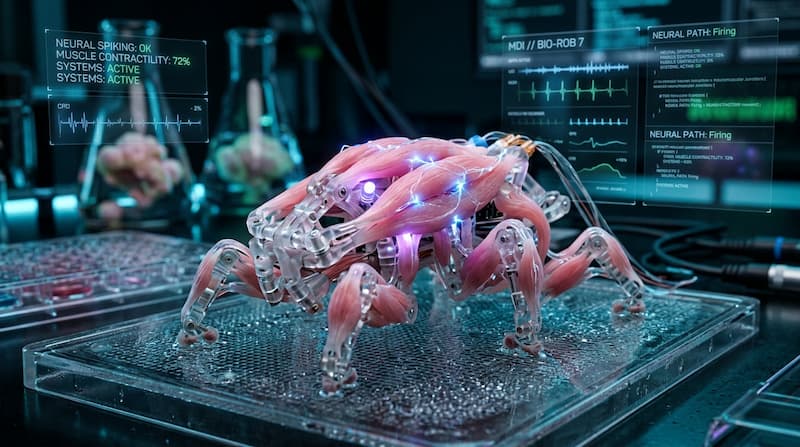
In early 2026, University of Illinois Grainger engineers unveiled a crawling biohybrid robot powered by living mouse muscle tissue and controlled by genetically engineered neurons that form real neuromuscular junctions. Light pulses trigger the neurons, the muscles contract, and the two-legged skeleton moves forward — sometimes even continuing after the stimulus stops.
This isn’t science fiction. It’s the latest step in biohybrid robotics, where machines grow their own soft actuators and control systems from living cells instead of motors and rigid electronics.
At BioComputer we see these systems as the physical embodiment of biocomputing: living neurons and muscle tissue working together as a hybrid biological computer that senses, decides, and acts in the real world.
From Rigid Motors to Living Actuators
Traditional robots rely on electric motors or pneumatics — powerful but stiff, energy-hungry, and poor at delicate or unpredictable environments. Biohybrid robots flip the script by using living skeletal or cardiac muscle cells as biological actuators.
These muscles are grown around 3D-printed soft polymer skeletons. When stimulated (electrically, optically via optogenetics, or by real neurons), they contract efficiently at small scales, self-repair, and consume far less power than conventional systems.
Recent advances have pushed performance dramatically. In March 2026, researchers reported the fastest skeletal muscle-driven biohybrid swimmer yet — an “OstraBot” that reached 467 mm per minute using self-trained, high-strength lab-grown muscles.
Neurons Take the Wheel
The real leap in 2026 is adding biological “brains.”
Teams now integrate motor neurons, spinal cord organoids, or even brain organoids with muscle tissue to create neuromuscular junctions — the same interfaces your body uses. In the Grainger work, genetically modified neurons respond to blue light from wireless micro-LEDs, fire, and trigger muscle contraction, producing coordinated crawling that shows signs of short-term adaptation.
Other groups are exploring:
- Nanomaterial-enhanced interfaces between neural tissue and muscle for better signal transmission
- Organoid integration for more complex sensing and decision-making
- Wireless bioelectronics that stimulate neurons without bulky external wiring
These systems blur the line between computation and action. A dish of neurons no longer just plays Pong on a chip — it can now drive a physical body.
Why Biohybrid Robots Matter for Biocomputing
Biohybrid systems represent the natural scaling of organoid intelligence and wetware computing into three-dimensional, embodied forms.
Living muscle provides soft, efficient actuation. Living neurons supply adaptive control and learning. Combined with synthetic scaffolds and soft electronics, the result is robots that are:
- Ultra-soft and biocompatible — ideal for medical applications inside the body
- Self-healing and adaptive — they can repair damaged tissue and adjust to changing conditions
- Energy efficient — muscle cells operate at biological scales with minimal power
- Programmable — optogenetics and emerging neural interfaces let researchers (and eventually software) direct behavior
Potential applications stretch from tiny biobots that swim through blood vessels for targeted drug delivery or cancer detection, to larger soft grippers for delicate manufacturing, environmental monitoring, or regenerative medicine.
Current Landscape in 2026
- Crawlers and Swimmers: Grainger’s neuron-controlled walkers and record-breaking muscle-powered swimmers
- eBiobots: Electronic-bio hybrids with wireless stimulation and integrated feedback
- Organoid Integration: Early experiments linking brain organoids to robotic bodies for more sophisticated sensing and response
- Commercial Momentum: The broader biohybrid robotics market is projected to grow rapidly, driven by demand for soft, biocompatible machines in healthcare and beyond
Challenges remain: keeping tissues alive long-term outside perfect lab conditions, scaling up size and strength, reliable long-term neural control, and serious ethical questions about sentience as these systems grow more complex.
The Bigger Picture: Machines That Grow and Learn
When machines grow their own muscles and brains, the boundary between tool and organism starts to dissolve.
This is biocomputing leaving the chip and entering the physical world — biology not just computing information, but acting on it with living efficiency and adaptability.
At BioComputer we track this convergence because it may redefine what “intelligence” and “robot” even mean in the coming decade.
References
- Min et al. (2025). Biohybrid robots with neuromuscular junctions. Science Robotics. https://www.science.org/doi/10.1126/scirobotics.adu5830
- Chen et al. (2026). Fast-swimming biohybrid OstraBot with self-trained high-strength muscles. Nature Communications. nature article
- Wang et al. (2026). Biohybrid robots evolutionized by soft electronics. npj Robotics. nature article
- University of Illinois Grainger College (2025). Advances in neuron-controlled biohybrid robotics. https://bioengineering.illinois.edu/news/biohybrid-robots
- Various reviews on organoid-integrated biohybrid systems (2025). MedMat and related journals.
Related: What is a Biocomputer in 2026? · Biological Data Centers: Scaling Wetware · Organoid Intelligence Explained
Feature image: AI-generated using Gemini.