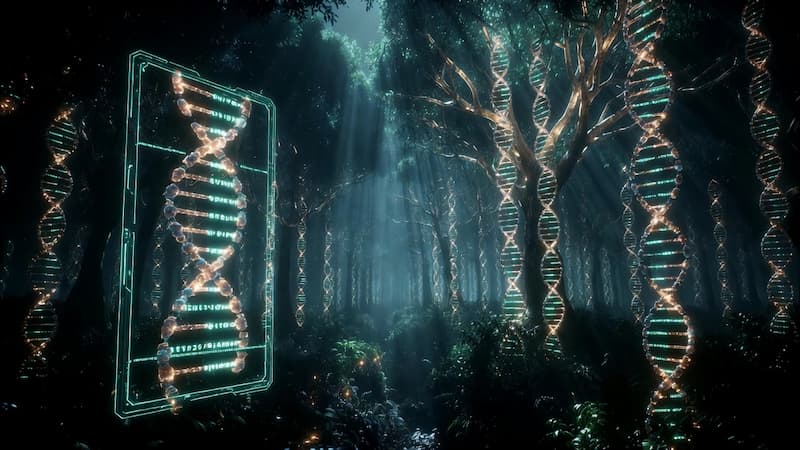
Evolution is a terrible programmer. It accumulates 3.8 billion years of patches, dead code, and workarounds — what Adrian Woolfson calls “spaghetti code” — because it cannot plan ahead. It only keeps what survives. In March 2026, Woolfson joined physician-scientist Eric Topol on the Ground Truths podcast to argue that this constraint is ending. The age of Artificial Biological Intelligence (ABI) — designing and booting up entirely new genomes using AI — has begun, and it changes everything about how we think about biology as an engineering substrate.
Woolfson’s book, On the Future of Species: Authoring Life by Means of Artificial Biological Intelligence (MIT Press, April 28, 2026), frames this as biology’s biggest phase transition since Watson and Crick. We moved from reading genomes (Sanger sequencing), to editing them (CRISPR), to now writing them from scratch. That third phase — authoring — is what ABI unlocks.
For biological computing, the implications are not peripheral. They are foundational. If you can design a genome, you can design a genome optimized for computation.
Three Eras, One Direction: Biology as Engineering
Woolfson’s framework is clean enough to be useful. Biology has passed through three sequential eras — and most researchers are still mentally living in the second.
The reading era was Fred Sanger’s gift: a library of sequenced DNA, vast but passive. We could study life’s source code but not rewrite it. The editing era brought CRISPR — targeted changes within existing genomes, powerful but still constrained by what evolution already built. Now comes the writing era: generating entirely novel sequences, assembling them into functional chromosomes, and booting up organisms that never existed.
Woolfson calls the enabling AI systems Large Language of Life Models (LLLMs) — biological counterparts to the large language models powering text AI. Trained on vast multi-omic datasets (DNA, RNA, proteins, regulatory interactions), these models learn the underlying “generative grammar of DNA.” They do not just predict sequences — they generate functional ones. Models like Evo, developed partly with collaborators at Genyro, Woolfson’s California-based synthetic biology company, are already demonstrating this capacity.
The jump from language model to biology is more than metaphor. DNA is a language: four-letter alphabet, combinatorial grammar, contextual meaning. LLLMs have become fluent enough to compose new sentences — and new organisms.
The Forest of Life — Unexplored Space Is the Point
The most striking concept in the Topol-Woolfson conversation is what Woolfson calls the Forest of Life. Evolution, despite its timescale, has only explored a tiny fraction of biologically possible designs. It is path-dependent: each step must survive to reach the next. Entire regions of biological design space — radically different metabolic architectures, novel protein folds, computation-native cellular logic — remain entirely untouched because no incremental evolutionary path leads there.
ABI changes the access model. Instead of following evolutionary trails, you can navigate directly. You are not constrained to variants of what already exists. You can ask: what would a cell look like if it were designed from first principles for information processing rather than survival?
This is not hypothetical for biocomputing. Cortical Labs and FinalSpark work with neurons shaped by 500 million years of evolutionary compromise — cells built for signaling in animal brains, adapted for dish-based computation. ABI offers a different starting point: design the computing substrate from the genome up. Specify the ion channels, the synaptic dynamics, the energy metabolism — not by luck, but by intent.
Woolfson’s term for this process is artivolution: artificial evolution, intentional design replacing random tinkering. The contrast with Darwinian selection is not incremental — it is categorical.
What “Refactoring Biology” Actually Means for Compute
Software engineers refactor code to remove cruft — legacy structures that work but make the system brittle, inefficient, and hard to extend. Biology has never been refactored. It carries every patch that ever survived selection, whether elegant or absurd.
Refactoring biology — Woolfson’s phrase — means rebuilding organisms around rational design principles instead of evolutionary inheritance. For biological computing, this opens three concrete directions.
First, minimal genome computing substrates. Existing work on minimal genomes (notably the JCVI’s Syn 3.0, a 473-gene organism) shows that you can strip life to essential functions. A minimal genome designed for information processing — with logic gate proteins, memory-encoding circuits, and controllable output — is a different engineering target than anything evolution produced.
Second, novel computing primitives. Silicon computation is constrained to the physics of electron movement. Biological computing operates on chemistry: protein conformational changes, ion gradients, gene expression cascades. ABI enables design of entirely new molecular switches, oscillators, and memory elements — not borrowed from natural biology but engineered for computational performance.
Third, energy architecture. One of BioComputer’s central arguments is the efficiency advantage of biological computation — FinalSpark’s Neuroplatform claims 1 million-fold energy efficiency gains over silicon for certain workloads. ABI allows direct optimization of the metabolic pathways that power biological computation, designing cells that consume minimal ATP while sustaining maximal computational throughput.
The Risks Topol Will Not Let You Skip
Topol, to his credit, does not let the optimism run unexamined. His counterpoints in the conversation are substantive.
The claim that ABI can produce “disease-free” organisms strikes him as premature. Disease is not a design flaw — it is often the shadow side of adaptive features (sickle cell trait as malaria protection being the classic case). Removing disease may remove fitness in ways we do not anticipate until it is too late.
More pressingly: biosecurity. A technology that enables genome authoring on demand is also a technology that enables the construction of dangerous pathogens. Woolfson and Topol both acknowledge that the same Molecular Gutenberg Press that prints therapeutic organisms can print harmful ones. The governance frameworks — regulatory, technical, international — are nowhere near ready for the speed of the science.
For biological computing specifically, the risk is lower than for human health or ecological engineering. A computation-optimized organoid in a sealed bioreactor is not a biosecurity threat in the same class as an engineered virus. But the precedent matters: the infrastructure, oversight models, and ethical frameworks we build for ABI in general will shape what is permissible in biological computing.
A Second Genesis for Biological Computing
Woolfson’s phrase Second Genesis is deliberately provocative — a designed origin of life forms that did not arrive through Darwinian processes. It reads as science fiction but is anchored in current work. Virus genomes have been synthesized from scratch. Bacterial chromosomes have been written and booted. Yeast chromosomes are being systematically replaced with designed sequences as part of the Sc2.0 project. The trajectory from there to designed eukaryotic cell types is steep but visible.
For the BioComputer project, Second Genesis is the enabling platform. The neurons powering today’s wetware computers were shaped by evolution for survival in animal brains — not for computation in bioreactors. ABI offers the prospect of cells designed, from the genome level up, to process information natively: predictable, controllable, manufacturable at scale.
Genyro, with collaborators including Brian Hie (Evo model) and Kaihang Wang on DNA synthesis, is building exactly this infrastructure. The stack — LLLMs generating sequences + scalable DNA writing + designed organism boot-up — is the precise technology pipeline that converts biological computing from proof-of-concept to engineered system.
Evolution had 3.8 billion years and no goal. ABI has a decade and a specification. The organisms that power the next generation of biological computers may not look like anything evolution ever built — because they were not built by evolution.
References
-
Topol, E. (2026). On the Future of Species: Adrian Woolfson and Artificial Biological Intelligence. Ground Truths Substack. https://erictopol.substack.com/p/on-the-future-of-species
-
Woolfson, A. (2026). On the Future of Species: Authoring Life by Means of Artificial Biological Intelligence. MIT Press. https://mitpress.mit.edu/9780262054898/on-the-future-of-species/
-
Topol, E.J., et al. (2025). Large Language of Life Models. Nature Biotechnology. https://rdcu.be/e89lQ
-
Hutchison, C.A., et al. (2016). Design and synthesis of a minimal bacterial genome. Science, 351(6280). https://www.science.org/doi/10.1126/science.aad6253
Related: What is a Biocomputer in 2026? · Programmable Biology: When Cells Become Living Software · FinalSpark Neuroplatform
Feature image: AI-generated using Grok.