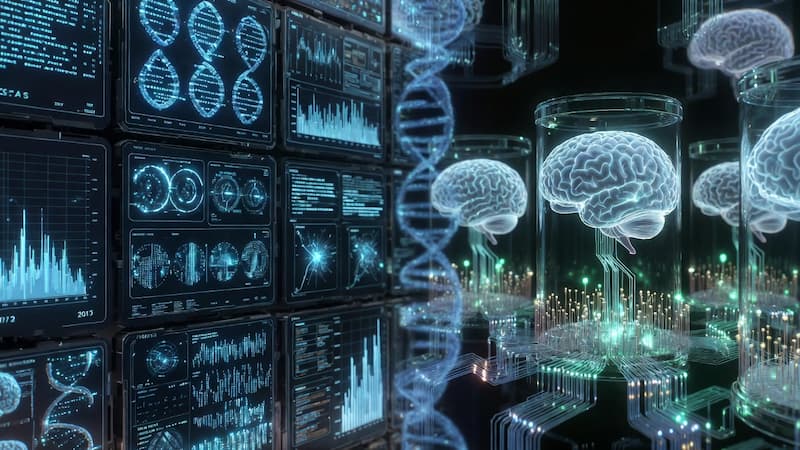
In March 2017, Florian Markowetz published a manifesto in PLOS Biology: all biology is computational biology. He showed how databases, mutational signatures, Next Generation Sequencing alignment, and quantitative maps of tumor heterogeneity turned fuzzy biological ideas into rigorous, testable science. Computation did not just assist biology — it reordered it.
Nine years later the thesis stands — and then gets surpassed.
We no longer run silicon code about biology. We grow living processors that are the code. Biology as computation has completed the inversion. The next modern synthesis is not training biologists to code. It is engineering cells, organoids, and gene circuits that compute natively in chemical space.
Markowetz Saw the Atlas — We Are Writing Executable Code
Markowetz described how computational tools created an “atlas of life” — Gene Ontology, transPLANT databases, statistical signatures of mutations shaped by replication timing or carcinogens. He argued that large-scale data from the human genome project and NGS made concepts like genetic heterogeneity measurable and clinically predictive.
He was right about the diagnosis.
But the payoff he envisioned — math and code absorbed into mainstream biology training — was only the first half. Today we close the loop. DNA becomes literal code. Neural organoids become adaptive processors. Gene circuits become logic gates. The substrate itself executes the program.
The Wetware Advantage Silicon Still Chases
A human brain runs on roughly 20 watts while performing feats of pattern recognition and real-time adaptation that embarrass most trillion-parameter models. Living systems deliver native parallelism, self-repair, and sample-efficient learning — exactly what the energy wall of conventional AI demands.
Recent milestones make the inversion concrete:
- Brain organoids now solve control-theory benchmarks like the cart-pole problem, demonstrating closed-loop adaptation beyond simple pattern matching.
- Roche’s Institute of Human Biology (opened March 2026 in Basel) fuses human disease biology, computational biology, and translational bioengineering to build organoid and organ-on-chip systems that replicate physiology with unprecedented precision — moving disease modeling from simulation to living computation.
- The emerging field of organoid intelligence explicitly treats 3D human brain cell cultures as biological computers capable of memorizing inputs, learning tasks, and interfacing with silicon for hybrid intelligence.
These are not tools for biology. They are biology as the programmable medium.
Synthetic-Programmable Biology Completes the Circuit
Early gene circuits — the repressilator, the toggle switch — proved cells could be engineered with logic. Today AI-designed genomes and CRISPR-tuned networks scale that vision toward on-body therapeutics, smart materials, and living data processors.
Synthetic-programmable biology turns Markowetz’s atlas into executable wetware. The same quantitative frameworks he championed now optimize DNA code, predict circuit behavior, and integrate organoids into hybrid stacks. The distinction between “pipette biologist” and “computational biologist” dissolves because the cell itself has become the computer.
The Hybrid Future Is Already Shipping
Silicon gave us the microscope and the simulator. Wetware supplies the machine — energy-efficient, fault-tolerant, and capable of learning from sparse data in chemical space no GPU can enter natively.
The energy demands of large-scale AI make this hybrid inevitable. Roche’s IHB, organoid intelligence platforms, and programmable gene circuits are not side projects. They are the first nodes of infrastructure where biology computes directly.
Where biology becomes programmable computation.
The next modern synthesis will not be taught only in classrooms. It will run in dishes, chips, and — eventually — inside us. The question is no longer whether biology can compute. It is how fast we scale the living stack before the physics of silicon forces the transition anyway.
References
- Markowetz, F. (2017). All biology is computational biology. PLOS Biology. https://journals.plos.org/plosbiology/article?id=10.1371/journal.pbio.2002050
- Smirnova, L., et al. (2023). Organoid intelligence (OI): the new frontier in biocomputing and intelligence-in-a-dish. Frontiers in Science. https://www.frontiersin.org/journals/science/articles/10.3389/fsci.2023.1017235/full
- Roche. (2026). Roche inaugurates new research home for the Institute of Human Biology. Roche Media Release. https://www.roche.com/media/releases/med-cor-2026-03-23
Related: Organoid Intelligence — The Next Compute Layer · Biological Data Centers Are Coming
Feature image: AI-generated using Grok.